Memories of the Land: Learning through Sacred Landscapes in the City of Tshwane
ABout the Author/s




Le cratère météoritique de Tswaing constitue un paysage sacré, propice à l’apprentissage et à la préservation du patrimoine culturel. Nous nous penchons sur le rôle — historique et actuel — que jouent ce site et ses gardiens dans la conservation et la transmission de mémoires, de savoirs et de pratiques autochtones essentiels. Nous mettons en lumière des réalités et des histoires culturelles souvent négligées, voire dévalorisées, dans des lieux tels que Tswaing, qui favorisent la transmission de connaissances immatérielles. En somme, ces sites s’apparentent à des paysages d’apprentissage: ils recèlent des savoirs précieux pour les communautés autochtones et offrent des perspectives d’enrichissement des connaissances, tant pour la recherche universitaire que pour la pratique professionnelle liées au paysage. La collecte et l’analyse de données qualitatives fournissent des exemples concrets du potentiel pédagogique des paysages. En s’appuyant sur des parcours sur le site, des observations paysagères et des récits oraux, cette étude illustre la manière dont des significations culturelles et spirituelles sont associées à des éléments spécifiques du paysage de Tswaing.
The Tswaing Meteorite Crater is a sacred landscape where learning occurs and cultural heritage is sustained. We focus on the historic and continuing role that the site, and its custodians have in the retention and transfer of important Indigenous memories, knowledge and practices. We emphasise the often overlooked, or undermined, cultural realities and histories of places such as Tswaing, that support the transfer of intangible knowledge. Essentially, sites like these are landscapes of learning - which hold significant knowledge for Indigenous communities, and opportunities for enhanced learning, for landscape academia and practice alike. Qualitative data collection and analysis provides illustrative examples of the potential for learning through landscapes. Drawing on site walks, landscape observations and oral accounts, the study illustrates how cultural and spiritual meanings are associated with particular features of the Tswaing landscape.
Introduction
In South Africa, Imbongi or Seroki, are local oral historians and custodians of sacred landscape knowledge, as are traditional healers’ custodians of sacred landscapes. However, outside of the Freedom Park project (Mufamadi, 2022), there are limited locally documented landscape design processes where traditional knowledge holders have been formally consulted. Despite arguments for local and Afrocentric approaches to African public environments (Young, 1990), and arguments for decolonial public space design processes (Landman & Makakavhule, 2021), Indigenous Knowledge Systems (IKS) have continued to be overlooked in mainstream design discourse. Consequently, this paper explores learning through the landscape by foregrounding IKS. The particular findings linked to this study include the value of a specific landscape, and various landscape features and vegetation as tangible conduits of human, and more-than-human relationships and knowledge transfer.
Study Background
Landscape architecture was formally established in South Africa in 1962, and as of 1993 was considered to consist primarily of ‘Environmental planning and Landscape design’ (Fourie, 1993). Documenting the evolution of the local profession, Fourie (1993) references European influences from the ‘Cape Dutch Period’, through to the 20th Century. And although the ‘natural environment’ is mentioned – no reference is made to the Indigenous communities who left their imprint on the South African landscape throughout this same period.
Contradicting the above narratives, the Bakoni ruins in Mpumalanga, are tangible evidence of people adapting the local South African landscape to their daily needs from at least the 17th Century (Delius et al, 2012). Much less is formally documented about these landscapes, especially within landscape architectural discourse. Similarly, sacred landscapes such as the Tswaing Crater are documented primarily as geological and natural wonders, and only secondarily as culturally significant landscapes – despite, in the case of Tswaing, communities utilising the site from as early as the Middle Stone Age (Reimold et al, 1999).
Problematically for South Africa, IKS (Seroto & Higgs, 2024) and relationships to the landscape were historically purposefully oppressed (Shackleton & Gwedla, 2021). Western-influenced management of land reduced the scope of Indigenous people’s relationship with South African landscapes, which have been largely represented as places to be measured, controlled and conserved in direct contradiction to their cultural value (Sinamai, 2022). Thus, the critical need to directly “challenge the dominance of western epistemologies” (Sebola-Samanyanga, 2025).
Valuable local reference material has been published (Stoffberg, Hindes & Müller, 2012), but with a tendency towards more contemporary (20th and 21st C) landscape concerns; suggesting gaps in the formal design literature linked to local South African IKS, and in the education of landscape architectural professionals. Yet, the work of Mufamadi (2022) does provide a valuable foundation on which to build in terms of IKS.
Indigenisation of Landscape Education
Locally, landscapes play a crucial role in the development, production and distribution of knowledge, through cultural and spiritual practices, performed in the landscape where they are inextricably linked to the rivers, mountains and forests.
Furthermore, in the Indigenous African setting a traditional leader, oral historian and / or spiritual healer assumes the role of educator, teaching through elements rooted in African IKS, as well as the land itself. These systems involve practices such as ascending the mountain to ask for rain, ritualistic cleansing that occur at wetlands and waterbodies, and the harvesting of medicinal plants. During these processes, participants, including community members and spiritual initiates engage as learners. But, even outside of these practices many South African rural residents, have an intimate understanding of place which is transferred through ongoing use of the landscape (Sebotsi et al, 2025). Seroto and Higgs (2024) further argue that education within Indigenous communities takes place through cultural and traditional ceremonies, including through music, dance, and intergenerational folklore stories.
IKS are thus, localised and multi-generational ways of knowing that continue to generate meaning through relationships between people and the environment (Tuke, 2022; Malapane et al, 2024). Here landscapes are living archives of local histories (Chilisa, 2019). Thus, reading and designing local landscapes should be directly influenced by the theories and stories of the people who have intimate knowledge of such landscapes. Ultimately, we argue for the indigenisation of local landscape knowledge and education, by incorporating Indigenous Knowledge holders, IKS and teaching into education and knowledge building processes (Thompson Rivers University, n.d.; Gaudry & Lorenz, 2018), which is also linked to decolonisation and reconciliation (Balcombe, 2025; Gaudry & Lorenz, 2018).
Within Indigenous worldviews and Indigenous pedagogies, learning is relational and situated within the environment; it is embedded within everyday life and rooted in community participation, experience, storytelling, ritual, movements, and intergenerational exchange (Seroto and Higgs, 2024). Thus, studying African pedagogies requires scholars and practitioners to immerse themselves through a process of experiential learning (Odendaal, 2013); which involves observations of the landscape without seeking to extract and exploit knowledge for economic gains.
Methodology
The main author conducted an interpretative case study, focused on Afrocentric landscape narratives at the Tswaing Meteorite Crater. The Tswaing Crater is a meteorite impact crater located north of the City of Tshwane, and managed by Ditsong: Museums of South Africa. The landmark was formed by a meteorite impact approximately 220,000 years ago, and is characterised by a salty lake at the center of an almost perfect circular topography (Reimold et al, 1999). The research focused on the Crater as a living spiritual landscape.
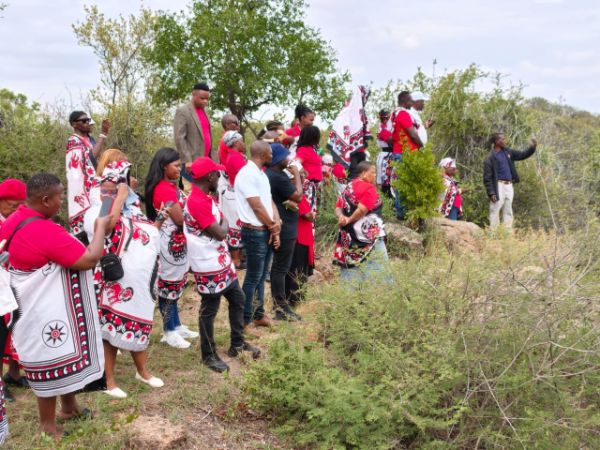
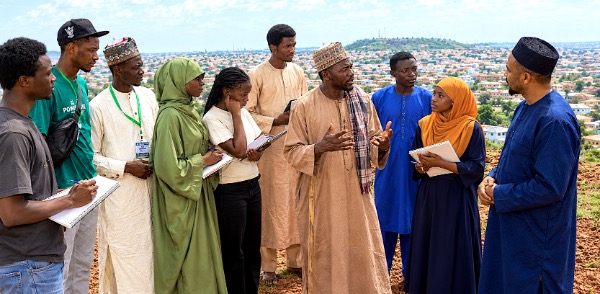
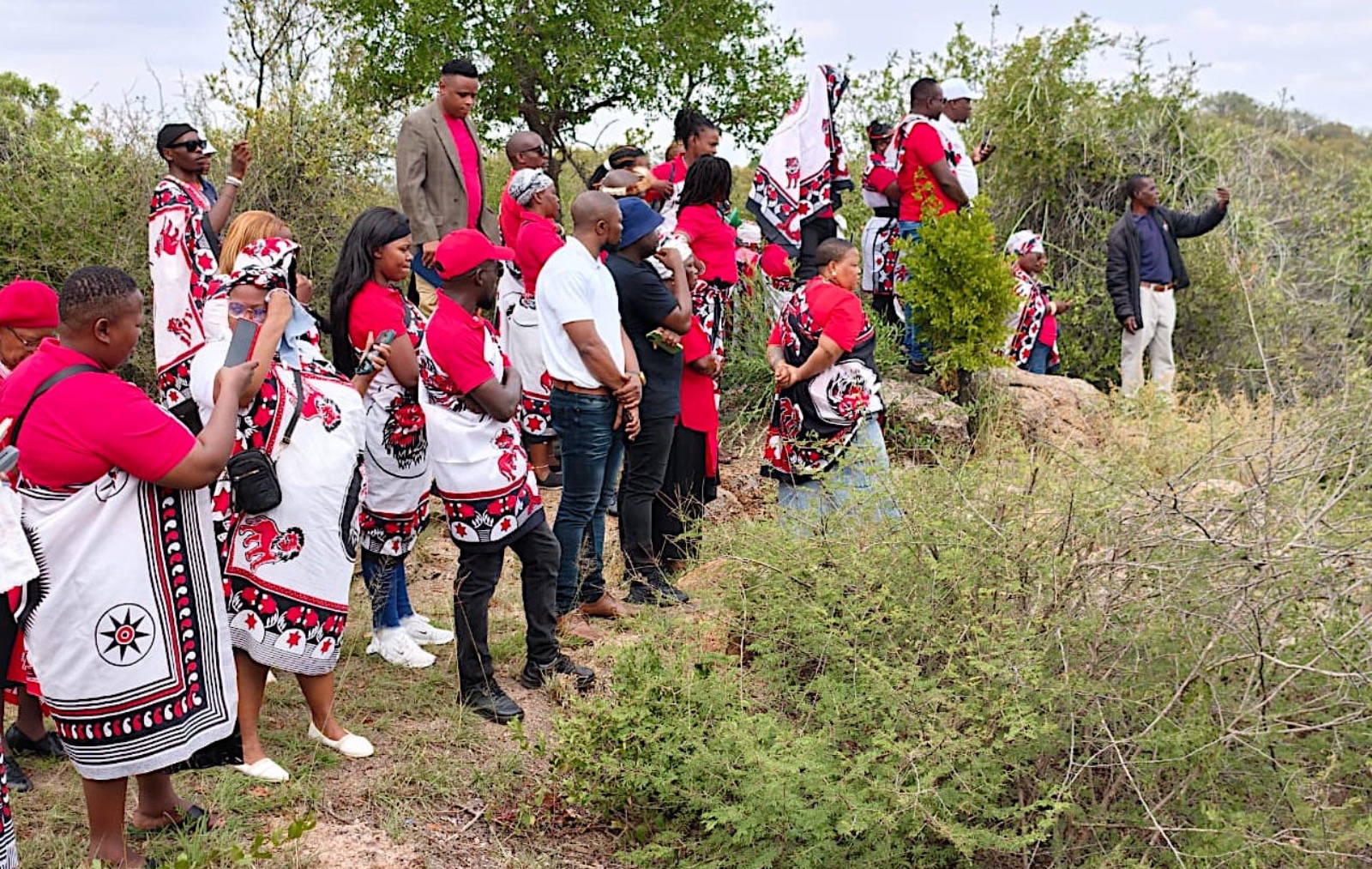
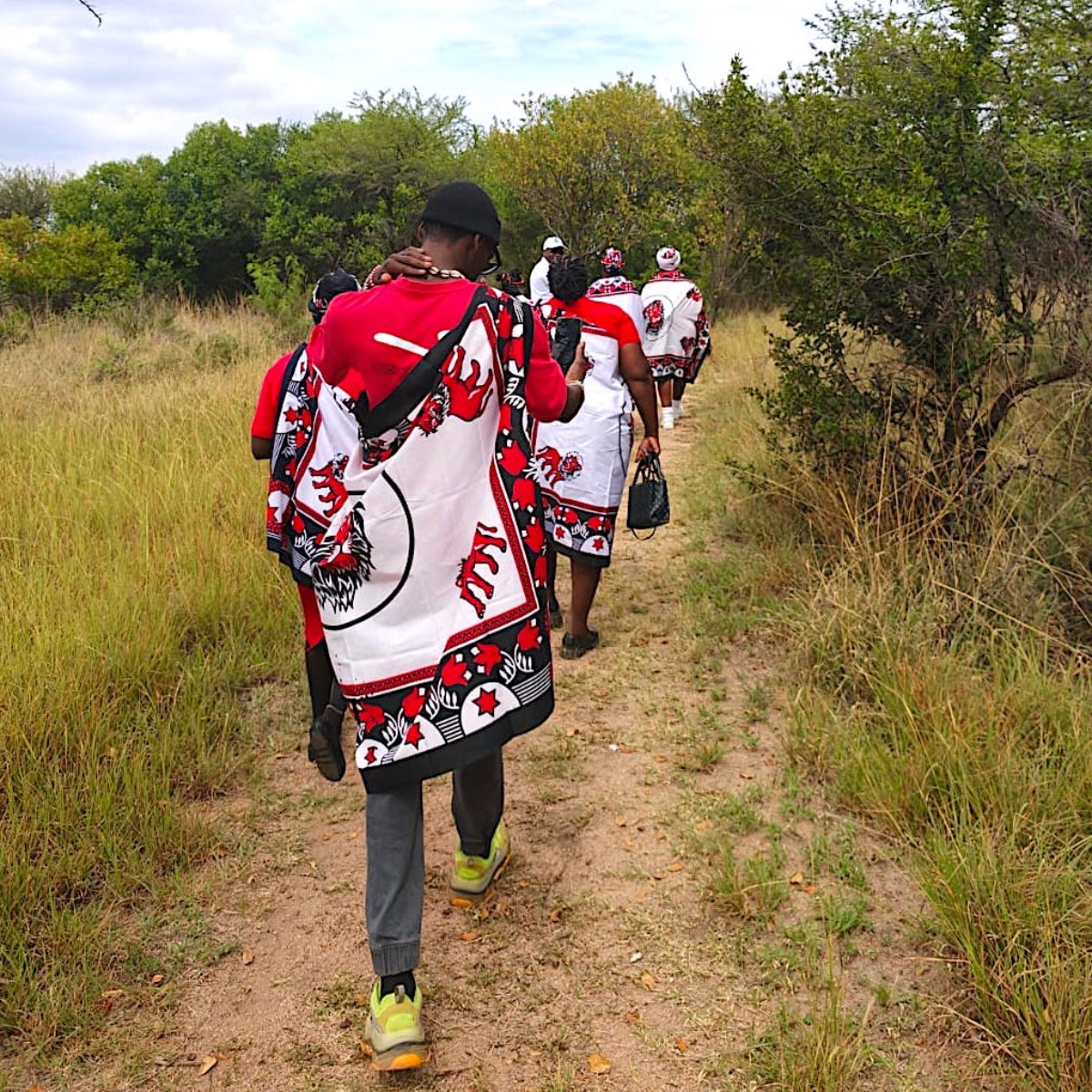
The methodology integrated two primary research tools. The first was spatial observation, undertaken through walking the landscape with the assistance of Tswaing security personnel, along vehicle and walking routes and the hiking trail, with the goal of mapping ritual and cultural activities and evidence. Observational evidence included remnants of candles, snuff containers and ashes. Security personnel familiar with the site assisted with initial access to specific locations, including the cave and water collection points, enabling observations to be related to the cultural and spiritual practices described in oral accounts. The second method included collecting oral narratives through semi-structured interviews with architects familiar with the site, Indigenous knowledge holders, traditional authorities and custodians, and Tswaing Crater personnel. The study incorporated ethnographic research (including attending cultural practices, heritage celebrations, and formal meetings with traditional healers, within Tswaing, which are not typically open to the public) to develop a multi-layered understanding of the sacred landscape. The site was visited from February to April 2026, and again in September 2026 during a Heritage Day celebration.
The research project falls under the EBIT Ethics approval (EBIT/41/2024) linked to the Storying the Landscape (STL) research project. Participants’ consent was sought for research participation and the use of information gathered during interviews.
Illustrative Examples of the Landscape as a Source of Knowledge and Cultural Memory
There is dual significance in the findings. We corroborate existing findings about plants and their value and present examples to illustrate important layers of knowledge not typically documented in local landscape architectural literature, but which students and academics are increasingly grappling with at the University of Pretoria.
Plants and their cultural value
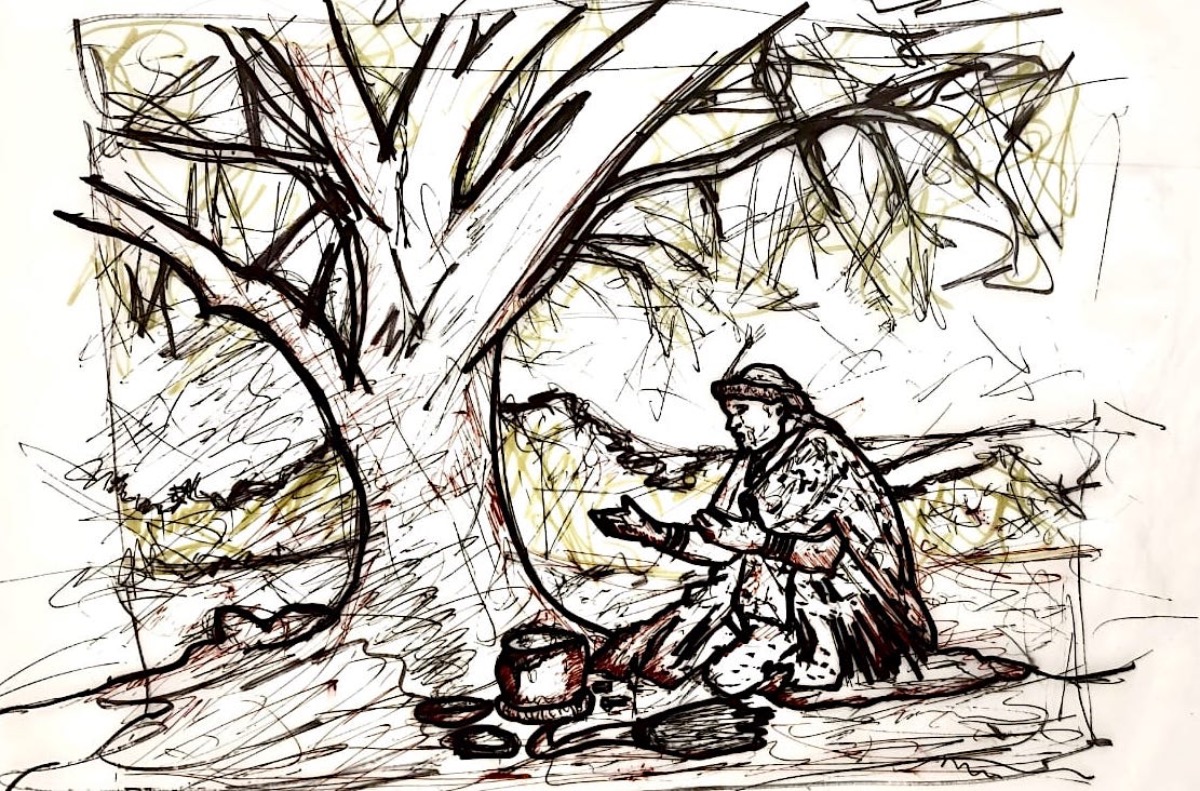
Proliferating on site, the Marula tree (Sclerocarya birrea or Morula / Umganu) fruits are traditionally used in the production of a beer enjoyed during communal gatherings and cultural practices. Oral testimonies reveal medicinal and spiritual use, particularly for cleansing and purification of the human body, and as a mediator to commune with ancestors. Accounts further highlighted the use of its bark in traditional healing and the placement of beer and snuff beneath the tree during communication with ancestors.
“The bark […] is also used to treat skin allergies. […] most people from Limpopo use the Marula tree as a mediator to talk to their ancestors. […] saying we're asking for rain, there is drought here. […] And they are sure that it's going to rain soon” (Tswaing educational officer, 2026)
Another spiritually important tree on site is the Buffalo Thorn (Ziziphus mucronata) (Umlahlankosi / Mokgala or Moonaona), which is mostly used for ukubuyisa / ‘go busa’ (meaning repatriation / retrieving / restoring) of a deceased person’s spirit or body.
“… they […] cut the branch of the buffalo thorn tree. […] they believe that they are taking the spirit of the person from where he died to home” (Tswaing educational officer, 2026)
Although the narratives linked to these trees has been reported on elsewhere, the significance here is that the trees facilitate specific human-nature interactions, indicating the inextricable relationships between people and nature. In Afrocentric worldviews – man is not separate from, or dominant over nature. Rather, non-human nature, ancestral spirits and living human-beings are a continuation of each other along a spectrum of the tangible to the intangible. Additionally, and importantly the plants also link people to their cultural and ancestral landscapes and communities of home, beyond the Tswaing Crater, and the City of Tshwane, i.e. the two examples above reference Limpopo, and the amaZulu cultural group concentrated in KwaZulu Natal.
Natural features as historical repositories
Further narratives depict the physical landscape as a historical archive and mnemonic device.
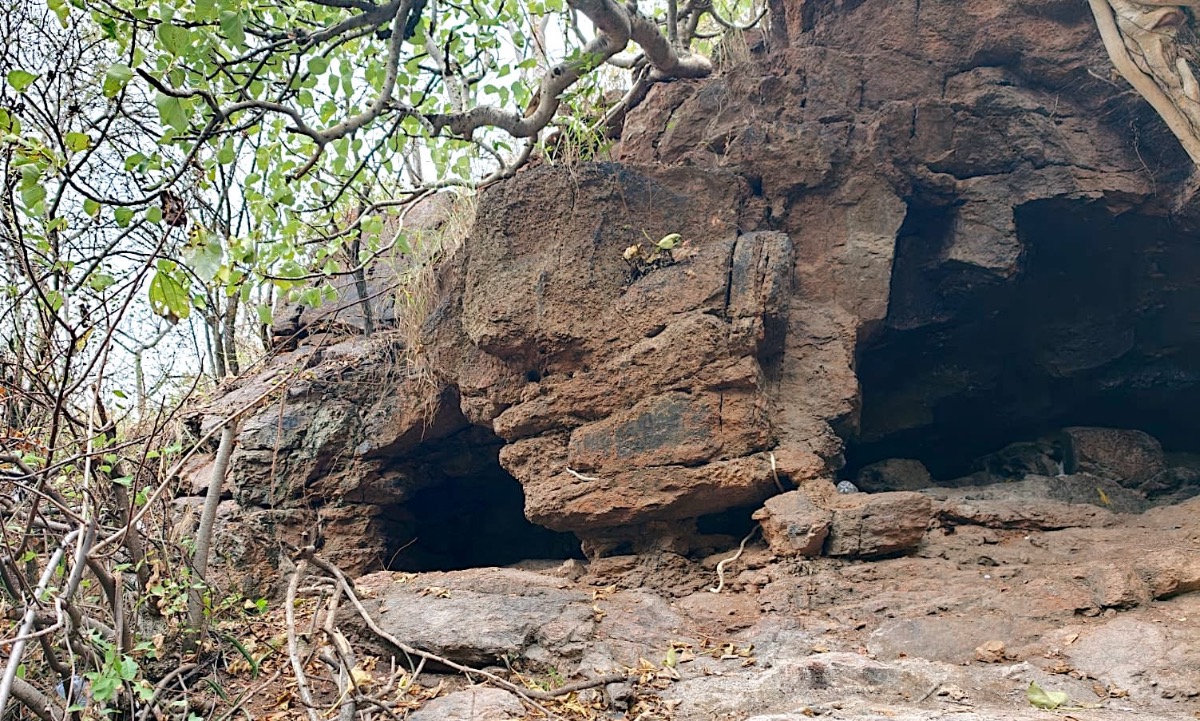
… their great-grandfathers used to live in those caves or grew up around those caves. And then those caves became stories for generations. Now, four or five generations later, we go to those caves to reconnect with our history” (Abba Amlak, 2026)
In Figure 3 caves have remnants of snuff containers and candles placed by those who come to ukuphasa / ukuphahla (communicate) with the ancestors in caves as sacred spaces. The place where ukuphasa practices happen, is considered significant to the practice (i.e. the ancestors recognise the place, and feel appeased there). The act of returning to significant landmarks and places with the landscape is an ongoing relationship between visitors, and their ancestors, and the land as a physical conduit of these relationships.
Custodians of sacred landscapes & spatial practices
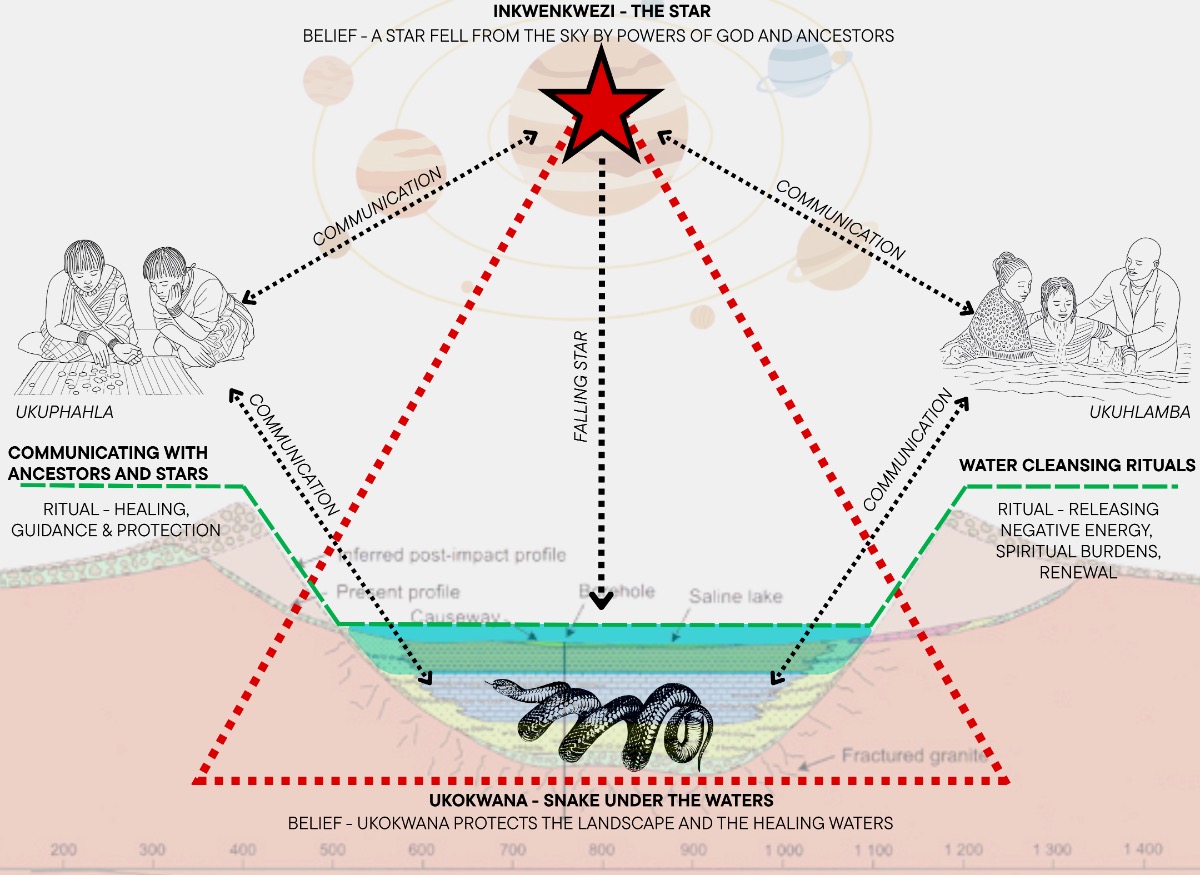
Another significant cultural aspect of the Tswaing Crater landscape is the belief that a snake called Kokwana (Old woman) resides underneath the salty lake, as the protector and the custodian of the landscape.
The beliefs attached to the history of the site remain a significant part of its sacred and cultural value. An extract from the ukuphahla at the beginning of a cultural meeting reinforces this belief:
[Translation: "Greetings, greetings. We report our presence to the custodians […] of Tswaing Ditsong, saying that today we have arrived here to step onto these grounds, and where we return from at the lake where the Star fell. Thank you very much, grandfathers (ancestors)"].
Figure 4 synthesizes the spiritual relationships described in the oral narratives gathered at Tswaing. These narratives connect the crater’s origin to a star falling from the sky, the presence of Kokwana beneath the lake, and ongoing communication with the ancestors. The diagram interprets these relationships as interconnected pathways through which the landscape (as a tangible feature) is understood and given cultural and spiritual meaning (intangible value). The interpretive illustration was developed by bringing together the narratives shared during interviews and the traditional leaders and spiritual practitioners meeting and ukuphahla / ukuphasa.
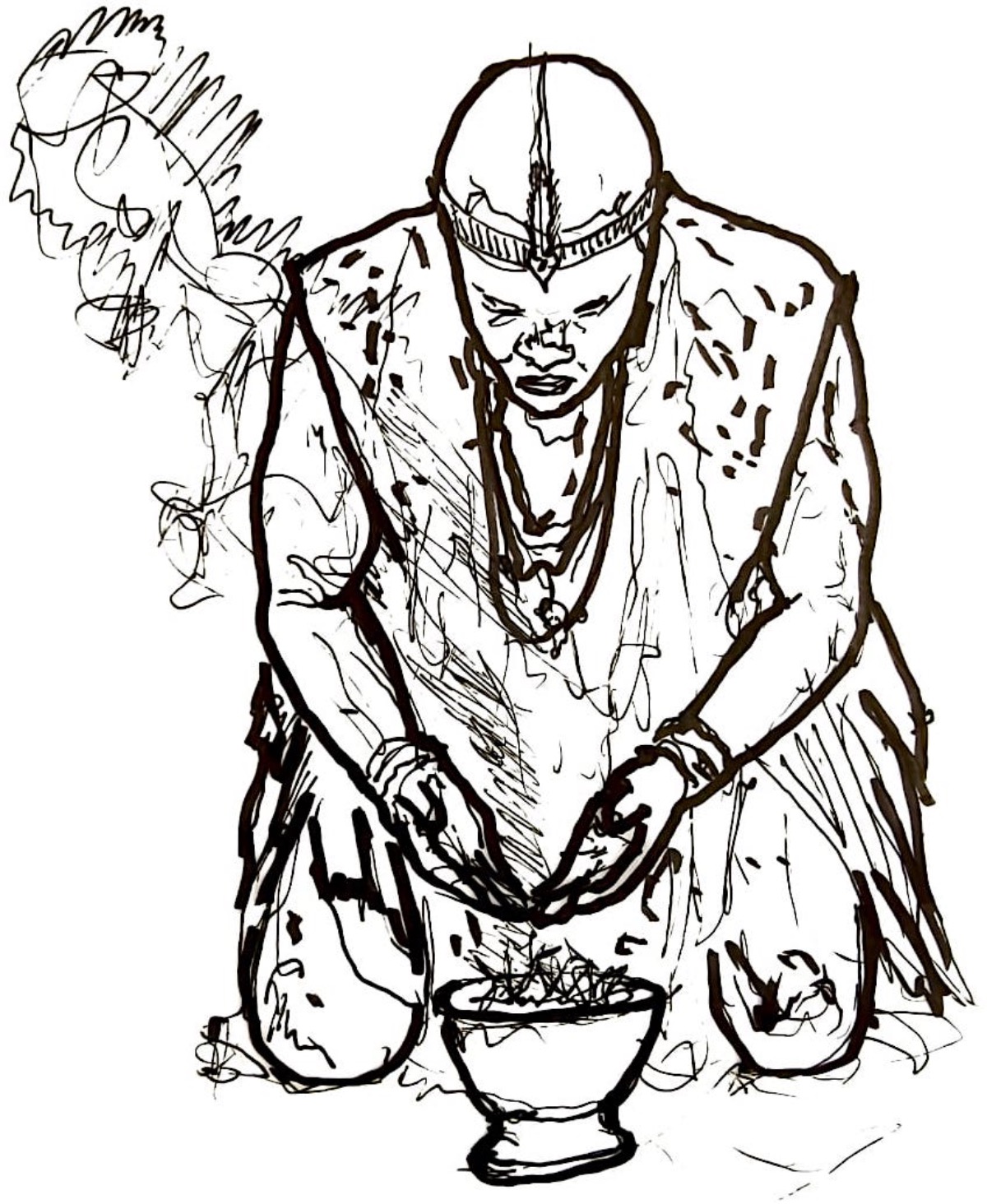
These practices indicate the continued use and value of the site for its spiritual and sacred connotations, above and beyond its natural, recreational or geological significance.
Conclusion
We believe that IKS should be incorporated into the teaching and learning about South African landscapes, to include the memories, history, and spirituality of Indigenous people.
We argue that the ongoing and regular use and interpretation of landscapes can be understood as an embodied process of learning through landscapes, on the basis that landscapes carry legends, symbols and Indigenous oral stories told by local historians and communities. We thus, foreground the landscape as the source through which knowledge is inserted and retrieved.
The narratives relating to caves as archives of memory and history, trees as tangible conduits for spiritual relationships and practices, and cultural connectors across different geographic locales, and the cultural perception of stars as sacred celestial bodies indicate an intertwined system of knowledge and interpretation rooted in nature. Indigenous people interpret and use landscapes from the lens of cultural practices and traditional methods of studying natural features (Mufamadi, 2022). This indicates IKS related observation, experience, and intergenerational learning as central methods of knowledge production (Tuke, 2022; Malapane et al., 2024). These interpretations also challenge colonial approaches and support decolonial perspectives that understand land as relational, as opposed to distinct physical and ecological entities.
For landscape education, this study suggests expanding approaches to include embodied learning (eg. including experiential visits and movement through the landscape, alongside “knowers” of the land, as was done in this study), oral traditions, and Indigenous pedagogies, as a process of learning through the landscape (Odendaal, 2013; Thompson Rivers University, n.d.; Gaudry & Lorenz, 2018). Learning through landscapes therefore becomes an opportunity to reposition sacred landscapes as educational spaces that contribute to the indigenisation of landscape knowledge in South Africa. In other words, the transfer of knowledge between ‘academics’ and ‘students’ should be expanded to include the custodians of such landscapes, as well as time spent more actively and intimately engaging with the landscape and its cultural value.
The indigenous value of plants has been documented in various plant handbooks and other resources. However, we reinforce the need to look beyond the ecological characteristics of landscape elements to understand the cultural values associated with them. The examples speak to the relational African worldview. Designers and landscape scholars are encouraged to consider how plants add or detract value within the public realm (Shackleton & Gwedla, 2021). Specifically, regarding the caves, the findings prompt further questions about incorporating landscape features and their cultural value into planning and educational frameworks, adding an additional layer to existing ecological frameworks. Additionally, there are opportunities for collaborative and co-created models of landscape conservation and management when considering the various landscape custodians, especially when local systems and more-than-human factors are also considered (Mufamadi, 2022).
Finally, we present an argument that authentic interpretation of various human-nature interactions and relationships can address the historically unbalanced prioritisation of ecological, geological, and visual narratives of place and a reliance on European models of landscape knowledge and education (Fourie, 1993) – to create a more balanced, equitable, and inclusive approach to South African landscapes.
References
Balcombe, E. (2025). Making space : Indigenous collaborations in the design studio, building community, and advancing reconciliation (T). University of British Columbia. Retrieved from https://open.library.ubc.ca/collections/ubctheses/24/items/1.0450061
Delius, P., Maggs, T. & Schoeman, M. (2012): Bokoni: Old Structures,New Paradigms? Rethinking Pre-colonial Society from the Perspective of the Stone-Walled Sites in Mpumalanga, Journal of Southern African Studies, 38:2, 399-414: 10.1080/03057070.2012.682841
Fourie, K. 1993. The origin and role of landscape architecture in Southern Africa. Unpublished Thesis. University of Pretoria.
Gaudry, A., & Lorenz, D. (2018). Indigenization as inclusion, reconciliation, and decolonization: navigating the different visions for indigenizing the Canadian Academy. AlterNative: An International Journal of Indigenous Peoples, 14(3), 218-227. https://doi.org/10.1177/1177180118785382
Landman, K. & Makakavhule, K. (2021) Decolonizing Public Space in South Africa: from conceptualization to actualization, Journal of Urban Design, 26:5, 541-555,DOI 10.1080/13574809.2021.1880885
Malapane, O.L., Chanza, N. and Musakwa, W. (2024) 'Transmission of indigenous knowledge systems under changing landscapes within the vhavenda community, South Africa', Environmental Science & Policy, 161, p. 103861. Available at: https://doi.org/10.1016/j.envsci.2024.103861 (Accessed: 23 June 2026).
Mufamadi, J., 2022. The influence of Indigenous knowledge systems in landscape and architectural projects. African Journal of Landscape Architecture, [online] (04)2. Available at:https://www.ajlajournal.org/articles/the-influence-of-indigenous-knowledge-systems-in-landscape-and-architectural-projects [Accessed 25 June 2026].
Odendaal, N. (2013). Experiential learning in African Planning Schools: reflections on the Association of African Planning Schools (AAPS) case study project. Revista Brasileira de Estudos Urbanos e Regionais. 15. 155. 10.22296/2317-1529.2013v15n1p155.
Reimold, W.U., Brandt, D., De Jong, R. and Hancox, J., 1999. Tswaing Meteorite Crater: An Introduction to the Natural and Cultural History of the Tswaing Region Including a Description of the Hiking Trail. Pretoria: Council for Geoscience (Popular Geoscience Series, No. 1).
Sebola-Samanyanga, K. J. S. (2025): (S)places and peace of (s)place: Venda’s sacred sites, International Planning Studies, DOI: 10.1080/13563475.2025.2460706
Sebotsi, L., Shand, D. and Breed, C.A. (2025) An African design approach for rural development, in Landman, K., Makakavhule, K. and Nay, E. (eds.) Decolonization and the Built Environment: Process, Product and Pedagogy. New York: Routledge, pp. 77–93.
Seroto, J. and Higgs, P. (2024) 'African Indigenous education in the postcolonial period: A critical reflection', Journal of Education, 95, pp. 148–168.
Shackleton, C.M. & Gwedla, N. (2021). The legacy effects of colonial and apartheid imprints on urban greening in South Africa: Spaces, species, and suitability. Front. Ecol. Evol, 8(13). https://doi.org./10.3389/fevo.2020.579813
Sinamai, A. (2022). Ivhu rinotsamwa: Landscape Memory and Cultural Landscapes in Zimbabwe and Tropical Africa. eTropic: electronic journal of studies in the Tropics. 21. 51-69. 10.25120/etropic.21.1.2022.3836.
Thompson Rivers University, (n.d.) Indigenization & Decolonization for Faculty. Viewed: 23 September 2026. Available online: https://www.tru.ca/__shared/assets/TRU_Indigenization_and_Decolonization_for_Faculty55117.pdf
Tuke, S.L., 2021. Partnerships for indigenous knowledge landscapes. African Journal of Landscape Architecture, (2), art. 4. Available at: https://www.ajlajournal.org/articles/when-landscapes-grow-from-indigenous-knowledge-systems(Accessed: 1 May 2026).
Young, G.A. 1990. ‘An Overview of Landscape Architecture in South Africa’, Aesthetic and Functional Values in Landscape Design Symposium, Athens, Greece, 23-26 September 1988. Panhellenic Association of Landscape Architects and Hellenic Society for Aesthetics. Pp 119 - 130.
Credits
This paper acknowledges the time, and information shared by various research participants including Tswaing Crater personnel, Abba Ayalew Amlak, and other anonymous contributions by traditional healers.
Furthermore, this research was supported by RDP funding from the University of Pretoria, for the Storying the Landscape Project.