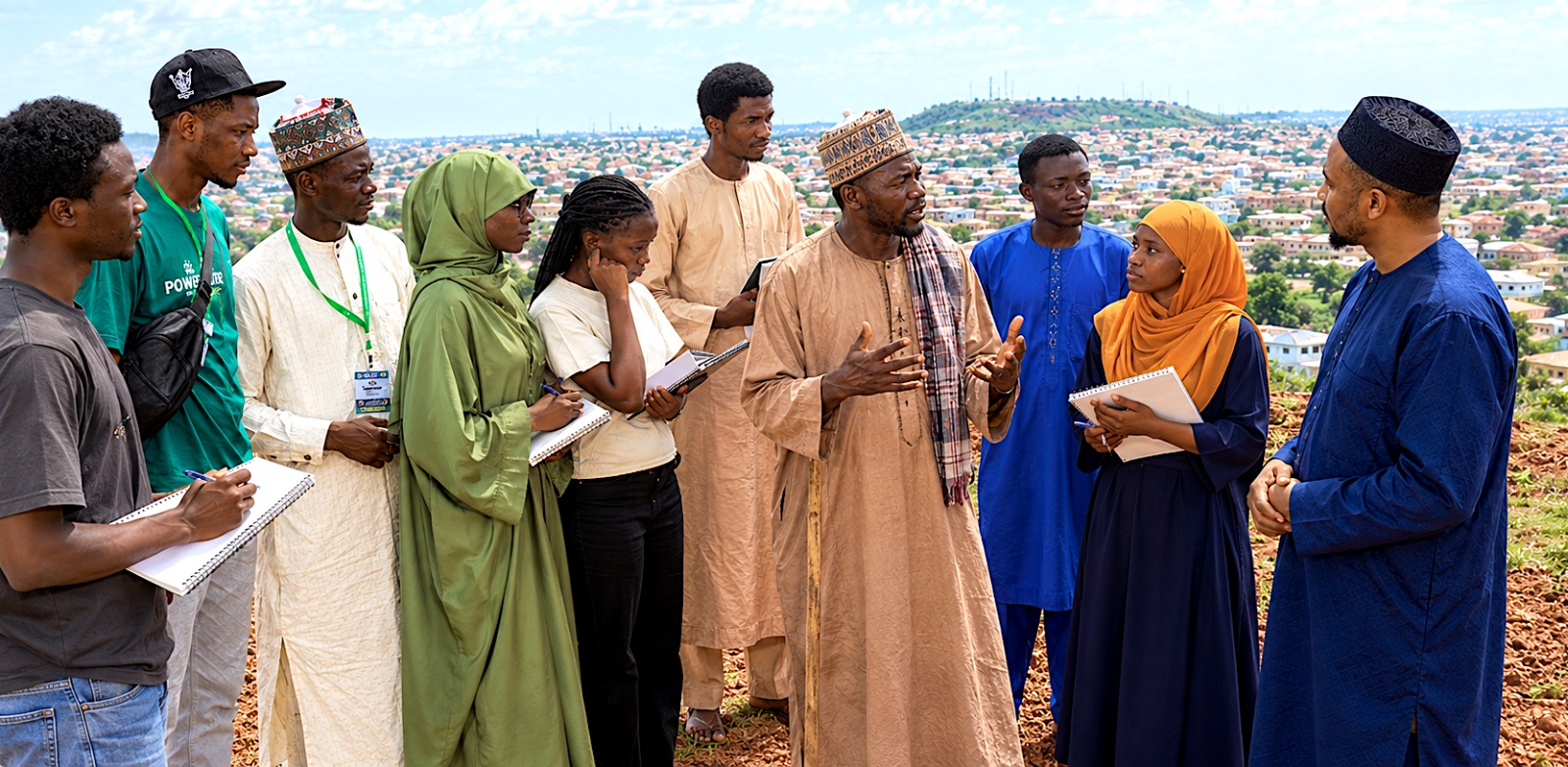
Learning through Doing: Landscape Education in Northern Nigeria
ABout the Author/s




La formation en architecture du paysage dans le nord semi-aride du Nigeria doit répondre à la pénurie d’eau, à la dégradation des terres et à la variabilité climatique au moyen d’approches de conception adaptées au contexte. Cette étude examine la manière dont des enseignants-praticiens facilitent l’intégration des savoirs écologiques traditionnels (SET) dans la formation en architecture du paysage à l’Université Ahmadu Bello de Zaria au cours de l’année universitaire 2024-2025. S’appuyant sur une étude de cas qualitative, menée sur un seul site et comportant plusieurs cas, elle analyse trois ateliers de niveau master : LARC801 Principes de conception paysagère (atelier I), LARC804 Échelle communautaire/urbaine (atelier III) et LARC828 Planification paysagère régionale (atelier IV). Les sources de données comprennent les documents pédagogiques et relatifs aux ateliers, les portfolios de projets des étudiant·es et les travaux finaux. L’analyse thématique porte sur l’intégration des SET dans les projets de conception, l’échange réciproque de connaissances entre le milieu universitaire et la pratique professionnelle, ainsi que les contraintes institutionnelles et pédagogiques. L’étude présente les enseignants-praticiens comme des traducteurs de savoirs, qui relient les connaissances écologiques issues des communautés à l’expertise professionnelle et à l’enseignement formel de la conception. Elle souligne l’importance d’adapter les pratiques écologiques locales aux défis environnementaux contemporains, plutôt que de les considérer comme des traditions figées ou de simples références esthétiques. L’étude recommande une intégration plus approfondie dans les programmes, une documentation éthique des savoirs locaux, la participation des communautés et des praticiens, ainsi qu’une collaboration interdisciplinaire afin de soutenir une formation en architecture du paysage adaptée aux enjeux climatiques.
Landscape architecture education in Sub-Saharan Africa faces a persistent challenge in reconciling inherited design paradigms with the ecological and cultural realities of local environments. This challenge is particularly acute in the semi-arid regions of Northern Nigeria, where land degradation, water scarcity, and climate variability require context-responsive approaches to spatial design. This study examines how teacher-practitioner pedagogy can facilitate the integration of Traditional Ecological Knowledge (TEK) into landscape architecture education and connect academic learning with professional and community-based ecological knowledge. Using a qualitative single-site multiple-case study at Ahmadu Bello University, Zaria, the study draws on curriculum and studio documents, student design portfolios, and semi-structured interviews with academic staff and practising landscape architects involved in studio teaching. The findings identify three interrelated processes: the pedagogical translation of TEK into climate-responsive studio projects; reciprocal knowledge exchange between professional practice and academic learning; and institutional and pedagogical barriers to sustained integration, particularly rigid course structures, inadequate documentation and limited interdisciplinary collaboration. The study conceptualises teacher-practitioners as knowledge translators who connect community-grounded ecological knowledge, professional experience and formal design education. It argues that TEK's value in landscape architecture education lies not in reproducing traditional practices as fixed models, but in enabling their critical interpretation and adaptation to contemporary environmental challenges. The study therefore recommends institutionalising TEK through community-based live-project studios, systematic knowledge repositories, flexible practitioner engagement and interdisciplinary collaboration. While grounded in Northern Nigeria, the findings offer transferable pedagogical principles for contextualising landscape architecture education in other climate-vulnerable and resource-constrained regions.
Introduction
Built environment education in Northern Nigeria prioritises resource-intensive Western aesthetics over locally responsive, sustainable approaches, despite severe pressures from water scarcity and land degradation (Suleman, 2024). Bridging formal design education and contextual practice requires drawing on Traditional Ecological Knowledge (TEK), a practice-based, generational system that offers viable design solutions, such as microclimate regulation and vernacular water harvesting (Toner et al., 2023; Battistella, 2026; UNESCO, 2022). However, formal curricula largely exclude TEK because of its oral nature.
This exclusion is exacerbated by traditional lecture-based teaching, which detaches learning from real-world contexts. In contrast, experiential, studio-based learning led by teacher-practitioners can effectively bridge academic theory, professional practice, and local insights (Ryan et al., 2025). Existing literature continues to treat studio pedagogy, decolonised education, and Indigenous knowledge in isolation (Toner et al., 2023), leaving a gap in understanding how practitioners practically translate Indigenous land and water techniques into contemporary design, rather than treating them as historical artefacts (Suleman, 2024).
Addressing these gaps, this qualitative multiple-case study examines landscape architecture design studios at Ahmadu Bello University (ABU), Zaria, Nigeria. It investigates how teacher-practitioners translate Indigenous knowledge into studio projects, facilitate reciprocal knowledge exchange between academia and practice, and navigate institutional barriers. Ultimately, the study demonstrates how practitioner-led pedagogy can integrate place-based ecological knowledge into contemporary design curricula, offering a scalable framework for climate-vulnerable, resource-constrained regions.
Literature Review
Pedagogical Disconnects in Sub-Saharan Built Environment Education
Built environment education in Sub-Saharan Africa is heavily influenced by Eurocentric models, leading to a mismatch when Western practices focused on formal aesthetics, synthetic materials, and infrastructure-heavy solutions are applied without local adaptation (Suleman, 2024; Vedasto et al., 2026). This gap is particularly problematic for landscape architecture, which relies directly on ecological and cultural contexts. In semi-arid Northern Nigeria, intense environmental challenges, such as desertification, soil erosion, and irregular rainfall require ecological responsiveness to drive design, rather than serve as an add-on (Ahmed et al., 2026; Okon et al., 2021). However, conventional studio education still treats environmental issues as technical adjustments, failing to prepare students for the demands of climate-stressed, resource-constrained regions (Oduwole et al., 2026).
Traditional Ecological Knowledge in Climate-Responsive Spatial Design
Traditional Ecological Knowledge (TEK) links localised environmental understanding with contemporary spatial design by documenting long-term community-environment interactions, ecological insights, spatial practices, and socio-cultural systems (Toner et al., 2023). It encompasses interconnected environmental observation, practical testing, cultural methods, and collective resource management, as illustrated by African dryland adaptations in rainwater harvesting, soil conservation, vegetation management, and community stewardship (Battistella, 2026; Fu and Stafford-Smith, 2024). While TEK's functional practices (e.g., rainwater collection, native planting, soil conservation, microclimate regulation) can inform climate-responsive landscape architecture, they must be critically adapted to modern contexts as dynamic, living systems rather than applied as static resources or decorative styles. However, integrating TEK into tertiary design education is hindered by its reliance on oral transmission and hands-on practice, which makes it less visible within codified academic systems (Yadav, 2026). Standard studio pedagogy consequently favours conventional literature and global precedents, often marginalising local knowledge or reducing it to aesthetic inspiration (Suleman, 2024; Vedasto et al., 2026). Overcoming this requires dedicated pedagogical frameworks that enable students to actively evaluate and apply locally grounded knowledge in contemporary design practice.
The Teacher-Practitioner Model and Design Studio Pedagogy
The design studio integrates theoretical, practical, and contextual learning through iterative problem-solving (Ryan et al., 2025; Oduwole et al., 2026). Incorporating teacher-practitioners bridges academic theory and professional reality (Coen et al., 2025) by providing tacit industry insights, such as site conditions, regulations, and implementation constraints, that standard materials lack. In African landscape architecture, these practitioners link academia, practice, and place-based knowledge, using real-world informal spatial practices, community water management, and local materials to translate ecological concepts into active design challenges (Gidado, 2025). Community-oriented, live-project methods further ground students' work in real social and environmental contexts (Coen et al., 2025).
However, practitioner involvement alone cannot overcome the challenges of integrating Traditional Ecological Knowledge (TEK). Practitioners often lack pedagogical training, and rigid institutional schedules, curricula, and assessment methods constrain flexible, field-based learning (Awang, Hamzah and Zulkifli, 2025). Thus, effective integration requires strong institutional support.
Without systematic documentation, cross-disciplinary coordination, and formal practitioner roles, TEK integration depends too heavily on individual initiative.
Identified Research Gap
Existing scholarship addresses decolonisation, Traditional Ecological Knowledge (TEK), and alternative approaches to design education in Africa's built environment, but treats these areas in isolation and does not examine how teacher-practitioners systematically integrate community-based ecological knowledge into formal landscape architecture studio pedagogy. Addressing this gap is critical in semi-arid environments, where climate variability, water scarcity, and land degradation require locally grounded ecological knowledge. Consequently, this study examines how teacher-practitioner pedagogy facilitates the integration of TEK into landscape architecture education in semi-arid Nigeria, and the institutional and pedagogical conditions that enable or constrain this process.
Methodology
Research Design and Context
This qualitative, single-site multiple-case study examined how teacher-practitioners facilitate the integration of Traditional Ecological Knowledge (TEK) into landscape architecture education. The design enabled an in-context examination of pedagogical processes, knowledge exchange, and spatial design practices across individual studio units (Toner et al., 2023), focusing on how professional experience and local ecological knowledge translate into studio learning.
Conducted at Ahmadu Bello University (ABU), Zaria, Nigeria, the research examined landscape architecture education within the institution's built-environment teaching context. Given the severe environmental pressures in Northern Nigeria, including land degradation, soil erosion, and water scarcity, locally tailored landscape approaches are essential. Consequently, the study investigated how teacher-practitioners linked these ecological realities to studio tasks and how students integrated traditional ecological knowledge (TEK) into their design proposals.

Data Collection
To evaluate pedagogical practice, knowledge transfer, and the application of TEK within the selected studio units, the study drew on three qualitative data sources:
- Curriculum and studio documents: The study reviewed briefs, course outlines, rubrics, and institutional frameworks for references to TEK, with an emphasis on dryland water management, indigenous land management, and community-based environmental stewardship.
- Student design portfolios and final project submissions: analysed to assess how TEK was translated into spatial layouts, site planning, planting strategies, climate-responsive design, and local land- and water-use practices.
- Semi-structured interviews with academic staff and practising landscape architects: Conducted to explore how teacher-practitioners bridged theory and practice, integrated local ecological knowledge, and navigated institutional opportunities and constraints.
Integrating these three sources enabled the study to assess alignment across the studio curriculum, student design outcomes, and instructors’ perspectives on knowledge transfer.
Data Analysis
The thematic analysis used a combined deductive-inductive, iterative approach across curriculum documents, student assessments, and interviews. It focused on three core areas: pedagogical methods for integrating Traditional Ecological Knowledge (TEK) into studio projects, knowledge exchange between practice and academia, and institutional and interdisciplinary constraints on integration. Cross-source triangulation across all three data streams validated the findings by analysing convergent and divergent patterns.
Results and Discussion
Analysis of Ahmadu Bello University’s curriculum documents, design studio assessments, portfolios, and semi-structured interviews identified three core themes that bridge theoretical inquiry, professional practice, and Traditional Ecological Knowledge (TEK). Specifically, the findings show that teacher-practitioners draw on their professional experience in studio instruction to guide students in translating local, place-based ecological knowledge into contemporary landscape design.
Translating Traditional Ecological Knowledge (TEK) into Design Studio Projects
Teacher-practitioners increasingly embed TEK into studio briefs, prompting students to treat indigenous environmental practices as functional principles for site-specific conditions rather than as mere aesthetic motifs, cultural references, or optional technical add-ons.
Student portfolios demonstrate this functional integration across several key areas:
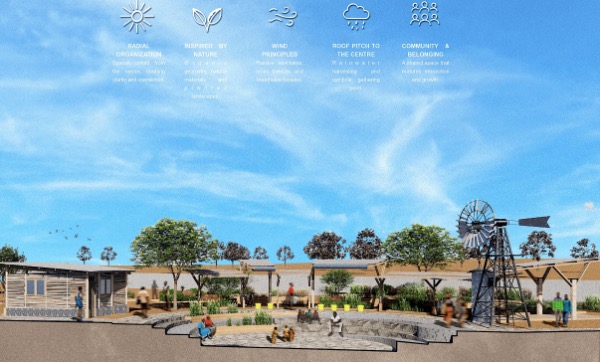
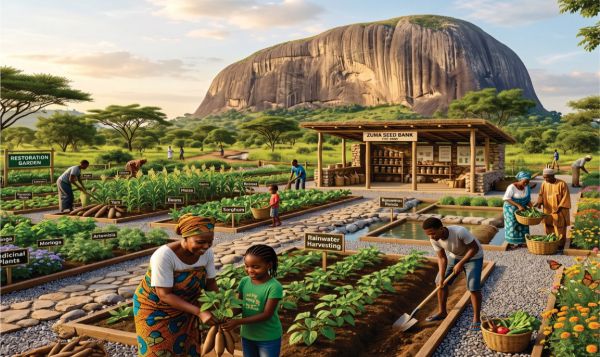
- Water Management: In semi-arid contexts, students applied traditional dryland water-harvesting techniques, such as bioswales, micro-catchment basins, and seasonal retention ponds, to work with local site conditions and seasonal flows rather than relying solely on resource-intensive infrastructure.
- Soil & Land Stabilisation: Proposals to address soil degradation combined native, drought-tolerant planting with traditional terracing to improve soil stability and mitigate erosion.
Overall, the portfolio evidence indicates that students did not merely replicate TEK as a static traditional practice. Guided by teacher-practitioners, they adapted and tested local ecological knowledge as an active design resource, moving from abstract sustainability discussions to situated, climate-responsive design decisions that connect culture, ecology, and contemporary landscape practices.
Reciprocal Knowledge Loops Between Practice and Academia
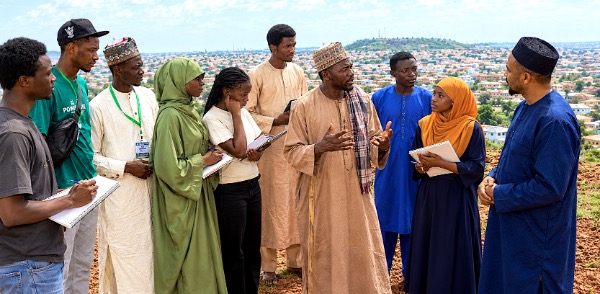
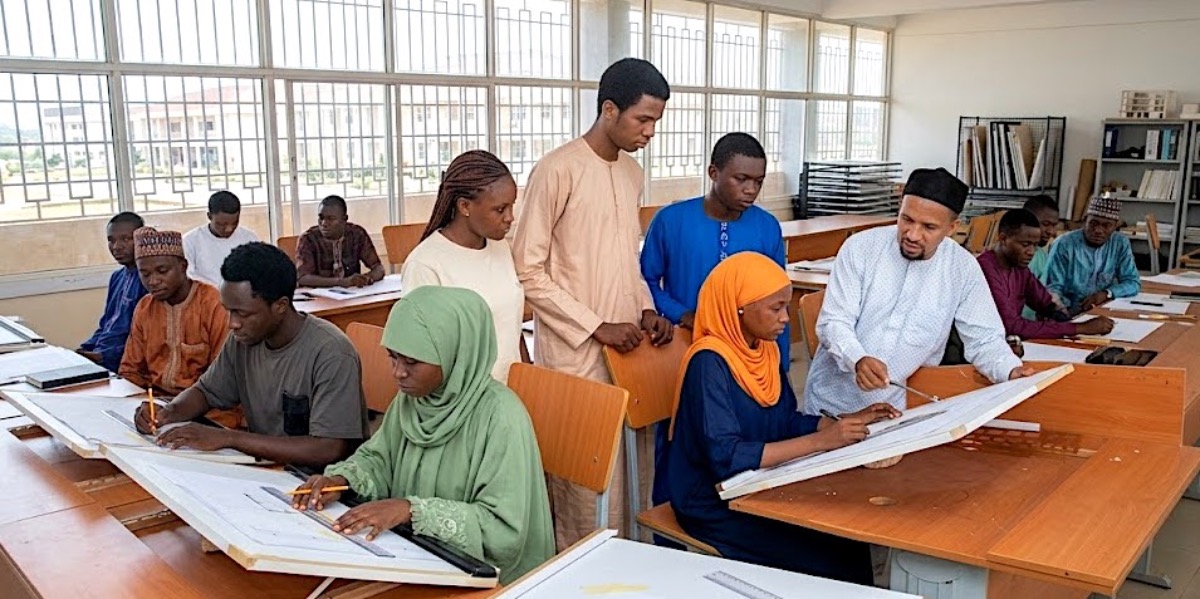
Academic staff and practising landscape architects engage in a reciprocal exchange of knowledge through the teacher-practitioner model (Figure 2). Practitioners introduce real-world design constraints, regulatory requirements, community perspectives, and current industry practices to studio environments, exposing students to authentic professional decision-making. Concurrently, practitioners use the studio setting to experiment with and refine concepts drawn from Indigenous environmental practices, allowing locally grounded approaches to be tested through students' exploratory work before they are applied to professional projects. Ultimately, this arrangement forms a dynamic knowledge loop that connects theoretical inquiry, practical experimentation, professional practice, and local ecological knowledge.
Institutional and Pedagogical Challenges
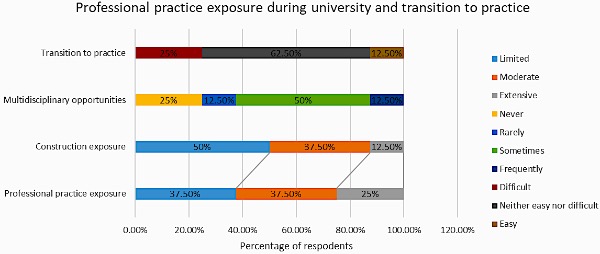
Despite these opportunities, three structural barriers hindered the long-term integration of Traditional Ecological Knowledge (TEK) into studio pedagogy, as shown in Table I: institutional rigidity, insufficient documentation, and limited interdisciplinary collaboration.
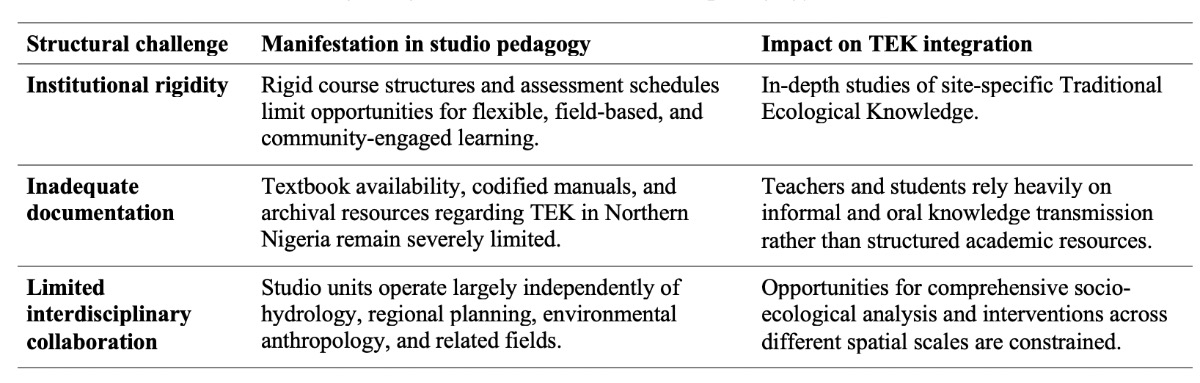
Teacher-practitioner pedagogy effectively bridges professional practice, academic learning, and place-based ecological knowledge. However, sustaining its long-term impact requires moving from isolated teaching efforts to institutional structures that systematically document, interpret, and integrate traditional ecological knowledge (TEK) into landscape architecture education.
Teacher-Practitioners as Knowledge Translators
Teacher-practitioner pedagogy offers value beyond bringing professional experience into design studios by connecting academic knowledge, professional practice, and place-based ecological understanding. This connection helps students address environmental issues through both theory and lived experience, which is essential in semi-arid contexts where landscape design must tackle water scarcity, soil degradation, and climate variability rather than follow traditional aesthetics. Consequently, these findings reinforce that studio education works best when theory is tested against real-world environmental and social realities (Odewole et al., 2026; Ahmed, Farooqui and Ahmed, 2026). Within this framework, teacher-practitioners serve as knowledge translators, guiding students to apply community-based practices to contemporary design challenges as adaptable methods rather than static traditions.
Pedagogical Translation and Student Learning
Integrating Traditional Ecological Knowledge (TEK) into studio projects shirts the focus from treating indigenous practices merely as historical or cultural references to examining its core ecological principles, such as dryland water harvesting, soil conservation, native planting, and microclimate regulation, to inform climate-responsive landscape design. This approach aligns with scholarship that defines TEK as a cumulative, adaptive body of knowledge formed through long-term environmental interaction (Toner et al., 2023; UNESCO, 2022) and addresses criticisms that traditional design education marginalises local insights by prioritising Western paradigms (Ramli et al., 2025). Ultimately, the core value of this finding lies in transforming how students interpret, test, and apply ecological knowledge in design practice.
TEK as Dynamic and Place-Based Knowledge
Traditional ecological knowledge (TEK) is best understood as a dynamic system of socio-ecological adaptation rather than a set of static techniques; practices such as fadama floodplain farming matter because they embody accumulated responses to specific environmental and social conditions. Consequently, their educational value lies in their underlying principles and relationships, avoiding the romanticisation or uncritical transfer of local practices. Instead, educators should guide students in critically adapting these locally grounded principles to contemporary challenges, aligning with efforts to codify TEK for Nigerian spatial planning (Elizabeth, 2026) and with broader calls to ground built-environment education in African contexts (Vedasto et al., 2026).
Institutional Conditions for Sustained Integration
Integrating Traditional Ecological Knowledge (TEK) currently relies excessively on individual champions and lacks structural support, documentation, and interdisciplinary collaboration (Lemi, 2019). To guarantee continuity, proposed strategies, including TEK repositories, flexible pathways, and community live-project studios (Hızlı Erkılıç, 2026), must be formally institutionalised. Although specific local practices (such as those from ABU Zaria) are context-bound, the overarching pedagogical framework for incorporating community knowledge remains transferable. This further supports built-environment decolonisation (Ramli et al., 2025).
Ultimately, institutions need to shift from ad hoc individual efforts to structured, collaborative curriculum frameworks.
Conclusion
This study shows that teacher-practitioner pedagogy enhances landscape architecture education in semi-arid Sub-Saharan Africa by integrating theoretical learning, professional experience, and Traditional Ecological Knowledge (TEK). At Ahmadu Bello University, Zaria, teacher-practitioners enabled students to engage with local land, water, and soil practices. They used contemporary design studios to test and adapt place-based ecological knowledge for modern environmental challenges, while serving as key translators of knowledge.
However, institutional rigidity, scarce documentation of TEK, and weak interdisciplinary collaboration limit sustained integration. To move beyond reliance on individual instructors, formal curricular structures and institutional support are required to embed community-grounded TEK. Although limited to a single institution, these insights offer scalable pedagogical principles for climate-vulnerable, resource-constrained regions across Africa.
References
Ahmed, S., Umar, H. and Muri, A.I. (2026) ‘Linking desertification dynamics with livelihood resilience: A review of integrated socio-ecological approaches’, Dutse Journal of Pure and Applied Sciences (DUJOPAS), 12(3b), pp. 233–246. https://doi.org/10.4314/dujopas.v12i3b.20.
Ahmed, Y., Farooqui, R.U. and Ahmed, S.M. (2026) ‘Contemporary pedagogical techniques in studio instruction to enhance quality in construction management and built environment education programs in the United States’, Buildings, 16(3), article 603. https://doi.org/10.3390/buildings16030603.
Awang, N.E., Hamzah, M.I. and Zulkifli, H. (2025) ‘Barriers to implementing innovative pedagogy: A systematic review of challenges and strategic solutions’, International Journal of Learning, Teaching and Educational Research, 24(3), pp. 679–698. https://doi.org/10.26803/ijlter.24.3.32.
Battistella, A.D. (2026) ‘Intelligent ecologies in architecture: From traditional ecological knowledge to circular design’, Architecture, 6(2), article 79.
Coen, A.N., Grove, R., Graybeal, C.D. and Calo, K.M. (2025) ‘Bridging theory and practice: Enhancing teacher preparation through collaborative partnerships’, PDS Partners: Bridging Research to Practice, 20(3), pp. 181–187. https://doi.org/10.1108/PDSP-05-2025-0009.
Elizabeth, O.A.F. (2026) ‘Integrating indigenous knowledge and practices into the curriculum for a sustainable science education in Nigeria’, Journal of African Philosophy and Indigenous Knowledge System, 3(1), pp. 26–46.
Fu, B. and Stafford-Smith, M. (eds.) (2024) Dryland social-ecological systems in changing environments. Singapore: Springer. https://doi.org/10.1007/978-981-99-9375-8.
Gidado, U.M. (2025) ‘Harnessing indigenous spatial practices for contemporary landscape design in Katsina State, Nigeria’, IFLA Africa, 31 October.
Hızlı Erkılıç, N. (2026) ‘Integrating inquiry-based learning into architectural design studios: Toward a flexible framework’, Journal of Asian Architecture and Building Engineering. Advance online publication. https://doi.org/10.1080/13467581.2026.2639102.
Lemi, T. (2019) ‘The role of traditional ecological knowledge (TEK) for climate change adaptation’, International Journal of Environmental Sciences & Natural Resources, 18(1). https://doi.org/10.19080/IJESNR.2019.18.555980.
Odewole, P.O., Adelabu, O.S., Afolabi, B.E.I.F. and Adeloye, A.A. (2026) ‘Cultural heritage-driven product design as pedagogical practice: Evidence from studio-based projects’, Design and Technology Education, 31(1), pp. 43–64.
Okon, E.M., Falana, B.M., Solaja, S.O., Yakubu, S.O., Alabi, O.O., Okikiola, B.T., Awe, T.E., Adesina, B.T., Tokula, B.E., Kipchumba, A.K. and Edeme, A.B. (2021) ‘Systematic review of climate change impact research in Nigeria: Implications for sustainable development’, Heliyon, 7(9), article e07941. https://doi.org/10.1016/j.heliyon.2021.e07941.
Ramli, R., Razali, R., Gadeng, A.N., Diana, N. and Hariadi, J. (2025) ‘Integrating local knowledge into higher education: A qualitative study of curriculum innovation in Aceh, Indonesia’, Education Sciences, 15(9), article 1214. https://doi.org/10.3390/educsci15091214.
Ryan, A., Morel, C., Goodman, J., Hermes, J., Abdur Rehman, M., Louche, C., Keranen, A. and Juntunen, M. (2025) ‘Learning to learn differently: Studio-based education for responsible management’, The International Journal of Management Education, 23(3), article 101177. https://doi.org/10.1016/j.ijme.2025.101177.
Suleman, T.A. (2024) ‘A review on implementing circular built environment in Nigeria through multidisciplinary approach’, RiSU Journal of Built and Natural Environment, 1(1), pp. 31–44.
Toner, J., Desha, C., Reis, K., Hes, D. and Hayes, S. (2023) ‘Integrating ecological knowledge into regenerative design: A rapid practice review’, Sustainability, 15(17), article 13271. https://doi.org/10.3390/su151713271.
Vedasto, R.V., Van Cleempoel, K., Hannes, E., Kalugila, S.L. and Phoya, S. (2026) ‘Towards a regionally grounded theoretical model of East African built heritage as a layered system: Implications for architectural education’, Heritage, 9(8), article 321. https://doi.org/10.3390/heritage9080321.
Yadav, D.S. (2026) ‘Bridging indigenous knowledge within formal education system’, in Indigenous knowledge system: Insights for a global future.