Learning as Second Nature
ABout the Author/s


La « Déclaration d’intention » de la Landscape Architecture Foundation (1966) appelait à une meilleure compréhension des processus naturels et au renforcement de la collaboration et de l’éducation. Soixante ans plus tard, le défi qu’elle pose reste d’actualité : comment faire en sorte que la compréhension écologique se traduise par une action collective plutôt que par un savoir spécialisé déconnecté de la vie quotidienne ?
« Landscape Learn » apporte une réponse à cette question. Cet article examine ses activités rendues publiques ainsi que des études de cas thématiques africaines potentielles. Il distingue les résultats rapportés des applications proposées, plutôt que de présenter une évaluation de l’apprentissage des participants. Son argument central est que la contribution transposable de « Landscape Learn » réside dans un cadre permettant de développer une capacité d’adaptation partagée : la capacité d’observer les changements environnementaux, de combiner différentes connaissances et de tester et réviser collectivement les décisions relatives au paysage.
The Landscape Architecture Foundation’s Declaration of Concern (1966) called for understanding natural processes and strengthening collaboration and education. Sixty years later, its challenge remains pertinent: how can ecological understanding become collective action rather than specialist knowledge detached from everyday life? 'Landscape Learn' offers one response. This article examines its publicly documented activities alongside potential African thematic case studies. It distinguishes reported outcomes from proposed applications, rather than presenting an evaluation of participant learning. Its central argument is that Landscape Learn’s transferable contribution is a framework for developing shared adaptive capacity: the ability to observe environmental change, combine different knowledge and collectively test and revise landscape decisions.
Landscape as a Place of Learning
As landscape architects, we are accustomed to asking what a place might become. Through Landscape Learn, we make room for an earlier question: what can this place teach us, and who should participate in that learning?
Our starting point is that people are integral to nature, not external observers of it. Designing a landscape therefore involves more than arranging its physical elements. It means considering how people inhabit living systems, how knowledge influences their decisions, and how responsibility for a place can be sustained. A planting plan, drainage strategy or public-space proposal should begin a continuing relationship between people and their environment, rather than conclude a design exercise.
Landscape Learn was established in 2016 as a social enterprise through which to explore these relationships beyond the boundaries of individual commissions. Its seasonal programme creates opportunities for students, practitioners and communities to learn together, with the landscape itself providing the setting, the subject and the solutions.
In considering landscape architectural practice in Africa, we see the value of this approach not as a programme to export, but as an invitation for reciprocal learning. The question is not how an approach developed in London might be reproduced elsewhere. It is how different experiences of land, water, settlement and stewardship might challenge and enrich one another in a time of rapid change.
African landscape architecture already has its own articulation of this responsibility. The African Landscape Convention (2019) recognises landscapes as expressions of ecological processes, cultural identity, memory and everyday life. It places community participation and respect for Indigenous and other locally grounded relationships with nature within the responsibilities of planning, design and management illustrating an agenda shaped within Africa.
Learning Together, in the Landscape
Landscape Learn grew from an interest in the connections between the arts, humanities and sciences. Its manifesto places practical experience alongside theory, and specialist knowledge alongside opportunities for wider participation.
Operationally, the landscape becomes both meeting place and subject of inquiry. Participants encounter a particular environment, hear contrasting interpretations and consider questions that extend beyond disciplinary boundaries. The combination of physical gatherings grounded in the place, and published or digital resources allows knowledge to circulate beyond an individual event. This is a complementary learning infrastructure, rather than a replacement for professional education or locally embedded expertise.
For transfer and evaluation, the approach can be formalised as a repeatable cycle: convene around a locally defined question; observe conditions together; interpret findings across different forms of expertise; agree and test an intervention; return at another ecologically meaningful moment; and share what should change. This cycle is proposed here as an operational development of the model.
Difference should be treated as genuinely productive: a farmer’s seasonal observations, a craftsperson’s material knowledge and a researcher’s measurements should inform the collective inquiry.
Personal development would mean learning to question assumptions, not simply accumulating information.
Seasonality is crucial to this proposition. A return visit should interrogate what an initial encounter could not reveal: whether vegetation survived, drainage functioned, shade remained accessible or maintenance arrangements endured. Learning becomes adaptive when these observations alter decisions.
One example is Growth and Decay, a July 2017 event at Kensal Green Cemetery. A guided walk was combined with talks involving landscape architecture, art, osteology, neuroscience and geology. A single landscape became the meeting ground for several ways of understanding time, matter and life, above and below ground.
For us, the significance of such an encounter is not that everyone leaves with the same interpretation. It is that the landscape becomes more complex, and more interesting, through their differences.
A scientist’s measurements, an artist’s observations and a practitioner’s experience generate questions that none would necessarily have raised alone, to break silo thinking.
The winter 2018 programme at the Garden Museum extended this inquiry through three themes: Right of Way, Critical Infrastructure and Taxonomy of Language. These conversations connected movement through landscape with questions of access, treated topsoil as critical infrastructure, and examined how language can enable inclusion through shared understanding or be used to exclude people from it.
These themes suggest practical questions for any exchange with African colleagues. Who defines the landscape under discussion? What has gone before? Which routes matter to those who use it? Whose vocabulary shapes the brief? Does the language of a workshop allow a farmer, maintenance worker or local craftsperson to contribute on equal terms with a visiting professional?
An open invitation is a beginning, not evidence that participation is equitable. We would rather make room for disagreement than mistake professional fluency for a shared understanding of place.
Soil, Trees and Ways of Knowing
The interest in learning also extends beyond live events. 'Conversations on Urban Forestry' (2019) explores relationships between people and urban trees through dialogue from multiple perspectives. 'Below Ground' (Gibbons and O’Hare), brings landscape architecture and soil science into conversation around the conditions needed for trees to establish in the urban environment over the long term. These are regarded as complementary forms of practice. A conversation may help people recognise something they had overlooked; a technical investigation can test how it functions; a design can give that understanding physical expression. Learning should move between these activities rather than remain confined to one of them.
A creative collaboration with Cape Town-based Wild Olive Artisans offered a more sensory example to explore the scent of soil. Beginning in 2018, the intent was to harness volatile molecules to which humans are fine-tuned, two uniquely crafted perfumes, Erde and Verda, evolved over a five-year period. This brought landscape inquiry into contact with the knowledge and techniques of perfumery. The intent was to draw attention to botanical life and the hidden world beneath our feet as a form of environmental activism; a message in a bottle of the precious and undervalued skin of the earth.
This is not a substitute for soil analysis, nor a model for landscape restoration. Its relevance lies in the range of ways through which people might become attentive to the dynamics of a landscape. Alongside drawings, surveys and scientific language, there is room for craft, material experience and reinvigorating a sensory intelligence. We should not assume that professional conventions provide the only meaningful route into environmental understanding.
From an Encounter to Continuing Care
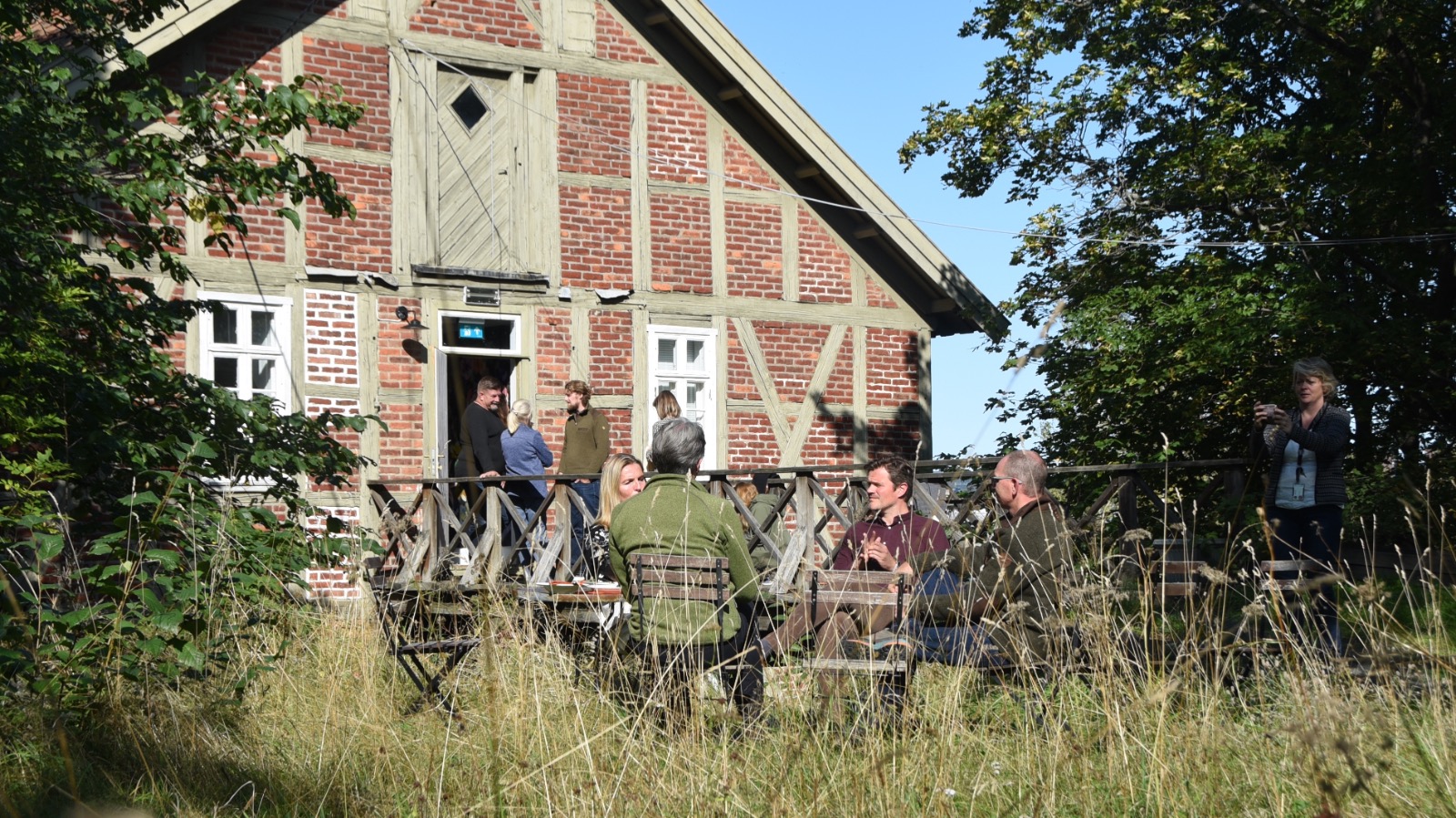
In Oslo, 'Meeting in a Meadow' gave this learning approach a direct relationship with a developing landscape project in which a collaboration with Oslo’s Agency for Cultural Affairs brought environmental scientists, naturalists, contractors, botanists and Munch Museum representatives together on Hovedøya. The gathering explored ecological and educational opportunities associated with Inger Munch’s Pier and a significant new public art commission, 'The Mother' by Tracey Emin.
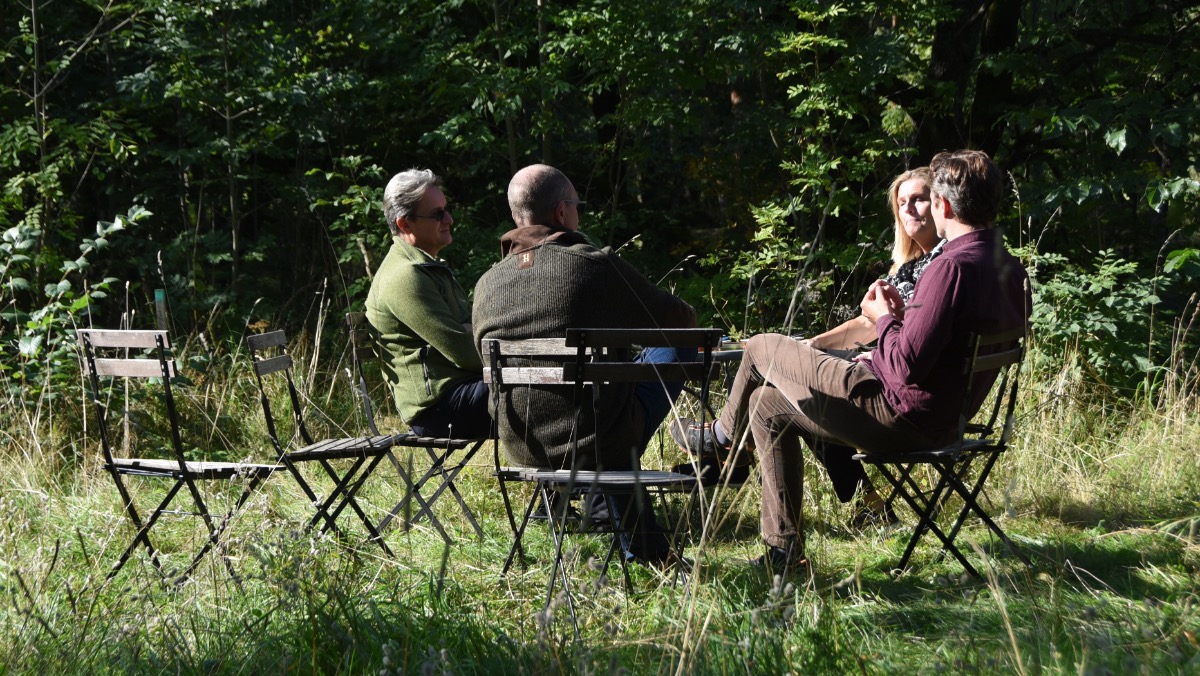
The discussion developed into annual ecological monitoring of the new calcareous meadow. The Norwegian Institute for Nature Research’s surveys examine urban bees and soil moisture; the published project account records additional solitary-bee species, including one considered threatened in Norway. We regard the continuity of this inquiry as particularly important as the encounter did not end when the participants dispersed. Instead it initiated an ongoing relationship between the Ministry of Cultural Affairs and the Norwegian University of Life Sciences recording the impact of flower meadows in cities and their affect on the diversity of bee-plant interactions.
However, monitoring provides evidence about a landscape’s development; it does not establish that a learning event alone produced ecological improvement. What the experience offers is a practical connection between convening, design, continuing observation and research impact.
That connection is central to how we should approach future collaborations. A return visit should be capable of changing a decision. Did the vegetation establish? Did water behave as expected? Is a space being used by those for whom it was intended? Can its maintenance arrangements endure? How can the landscape catalyse greater inside-out connectivity?
Without the possibility of revision, observation risks becoming documentation rather than learning.
African Practice: Adaptation rather than Replication
For us, speaking about Africa requires resisting the convenience of a single continental prescription. The African Landscape Convention (2019) explicitly encompasses natural, cultural, rural, urban and peri-urban environments, including ordinary and productive landscapes as well as exceptional ones. Its breadth is a useful reminder that landscape practice should not be reduced either to conservation scenery or to an account of environmental crisis.
Any collaboration should begin with the particular place, the soil and the people already engaged in shaping it. We would expect local practitioners and communities to determine the questions, the relevant knowledge and the rhythm of the work. Seasonality, for example, should not default to a European four-season calendar. Aprogramme might instead follow rainfall, planting and harvesting, flooding, dry periods or the times when access to water and shade becomes most critical.
This also changes what we mean by a “biome-positive” approach. We would use the term to describe strengthening the ecological processes appropriate to a place, alongside the livelihoods that depend on them — not imposing a universal appearance or a target for tree cover.
Landscape architects have a specific contribution to make within this exchange. We can connect observations to spatial decisions: where water should move, which ground should remain undisturbed, how access can be maintained, and how a proposal can be built and cared for. Participation does not remove our technical responsibilities. It should make our design judgement better informed and more accountable. The following African precedents offer ways to examine that proposition.
Regeneration, Drought and Food Security
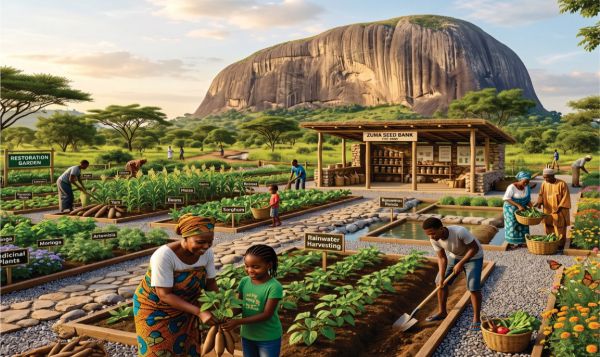
For a landscape architect, the important question is not simply how many trees might be retained. It is how regeneration relates to crops, grazing, household priorities and the rights to use the resulting resources. Susan Chomba et al (2020) make clear that farmer choice, ecological conditions, land and tree tenure, and relationships between cultivators and pastoralists all influence the possibilities for this approach. It also cautions against prescribing tree densities without understanding context.
A locally led learning collaboration could bring farmers, pastoralists, students, landscape architects and extension workers together around demonstration plots. Rather than arrive with a preferred intervention, participants could compare pruning decisions, crop performance, soil moisture, soil stabilisation and access to useful products over successive agricultural seasons.
We would want such a programme to ask who are the sponsors who undertake the work and who receives the benefits. Existing knowledge should help determine what is tested, not merely be recorded after the experiment has been designed. Protecting regeneration must also remain part of a wider conversation about the pressures driving clearance and degradation. It should not become a convenient substitute for confronting those pressures.
The professional lesson is one of restraint as well as intervention: learning when to protect, when to modify and when not to plant.
Water as a Productive and Shared Landscape
We see an opportunity here for learning that connects design directly with management and a catchment based approach of upstream thinking. Repeated visits involving residents, growers, municipal staff and researchers could examine water quality results alongside maintenance practices and the experience of using the treated water.
For landscape architects, the design questions would include the relationship between treatment areas and public access, the choice of planting and materials, and the provision of space for inspection, repair and change. A productive landscape should not transfer unacceptable risks to the people expected to maintain or use it. Such experimentation should complement public responsibility for biodiversity, sanitation and water infrastructure, not displace it.
Public Space, Livelihoods and the Everyday City
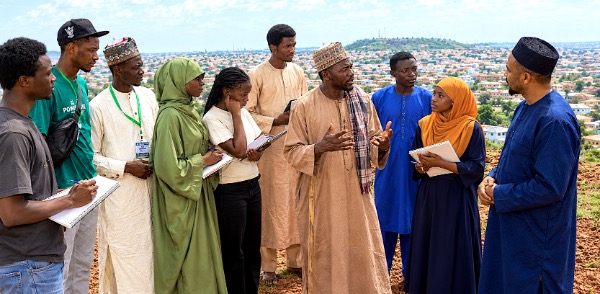
A Landscape Learn exchange could build on this kind of established participatory practice through resident-led walks, story-telling, flood mapping, material-making workshops and maintenance reviews. Visiting practitioners should be learners as well as contributors. We would want residents’ priorities to shape what is investigated, rather than invite them to comment on a question already settled elsewhere, out of context.
There is also a connection with the interactive Greener, Cooler, Healthier platform, launched in June 2026 in London’s Climate Action Week in record-breaking temperatures. Developed through research with academic partners, it uses mapping to communicate opportunities for protecting mature trees and introducing new canopy in London. It offers an example of making research visible at the scale of streets and neighbourhoods, through animation, spatial analysis and a collaborative approach.

A proposed adaptation in an African city would require its own evidence and priorities. Neighbourhood groups might map exposed walking routes, existing shade, waiting places, community facilities and opportunities to rest, then compare their observations at different times of day and across hotter and cooler periods. Such an exercise should ask not only where shade is absent, but who can use the shade that already exists. This would be an adaptation of a method of inquiry not a claim that findings or design standards can be transferred unchanged between cities.
Making Learning Part of Professional Responsibility
The thread connecting these examples is what we understand as shared adaptive capacity: the ability to notice environmental change, bring different kinds of knowledge into discussion, and revise decisions together. For Landscape Learn, a next step could be to make this process more explicit. A locally hosted collaboration might begin with a university, community organisation and relevant public authority agreeing a specific question. Before the first gathering, partners would establish who can make decisions, what resources are available, and how the work will continue.
This is also where learning should enter the professional brief. Returning to a site, speaking with those who maintain it and revisiting the management plan should not depend entirely on goodwill post construction completion. These are activities that should be considered when programmes, fees and responsibilities are established at the start.
Equity requires genuine and practical provision. Translation, travel, accessible venues, childcare where needed and payment for community expertise should be considered part of delivery. Records should be available offline as well as digitally, and participating communities should retain a say over how their knowledge, images and data are used. These commitments are central to the accountable learning process proposed in the original framework.
We would also distinguish adaptation from other environmental claims. A project’s contribution to water management, food production or shade is valuable in its own right; it should not be presented as proof of net-zero performance without a separate assessment.
Conclusion
Landscape Learn’s strongest proposition is that landscape understanding can be cultivated through shared encounters and sustained observation. Its Oslo activity offers a reported example of discussion developing into monitoring and research streams; African precedents demonstrate how comparable learning can be embedded within regeneration, water management, livelihoods and community governance.
Its relevance to African landscape architecture therefore rests on reciprocal adaptation and a commitment to evidence gathering and knowledge-sharing over time. The ambition is not to make every place resemble an exemplary project, but to enable people to question, care for and revise the landscapes they inhabit.
Nature-based solutions become second nature when learning continues beyond design, and responsibility continues beyond the event .
The adaptability of this model means it can easily align with life-long learning in academia, in practice and beyond, to encourage cross-disciplinary collaboration and spark new ideas.
References
Chomba, S., Sinclair, F., Savadogo, P., Bourne, M. and Lohbeck, M. (2020) Opportunities and constraints for using farmer managed natural regeneration for land restoration in Sub-Saharan Africa, Frontiers in Forests and Global Change, 3, article 571679. https://doi.org/10.3389/ffgc.2020.571679
Gibbons, J. 2019. Conversations on Urban Forestry. Landscape Learn.
Gibbons, J. and T. O'Hare, Below Ground: City Silviculture and the Art and Science of City Soils. Poetry: Steven J. Fowler. J&L Gibbons.
IFLA Africa (2019). African Landscape Convention. https://www.iflaworld.com/knowledge-hub-blog/ifla-africa-landscape-convention
J&L Gibbons (2026) Greener, Cooler, Healthier. https://storymaps.arcgis.com/stories/7bbfe4a71a0c43bba6d5347f6b96f105
Landscape Architecture Foundation (1966) Declaration of concern. https://www.lafoundation.org/who-we-are/values/declaration-of-concern
Credits
Landscape Learn. https://www.landscapelearn.com/about
Growth and Decay. A collaboration between Landscape Learn and Steven J. Fowler at Kensal Green Cemetery, London, July 2017, including a film by Tereza Stehlikova.
Garden Museum winter programme. Landscape Learn, Garden Museum, 2018. Contributors: Sarah Blee, Liza Fior, Orlando Gibbons, Rob Mackenzie, Jonathan Spencer, Steven Fowler, Dominic Lippa and filmmaker Tereza Stehlikova.
Erde and Verda. A creative collaboration between Johanna Gibbons and perfumer Madalina Heneck, creative director of Wild Olive Artisans.
Meeting in a Meadow. Landscape Learn and Kulturetaten, Oslo’s Agency for Cultural Affairs. Hovedøya, Oslo, 16 September 2019.
Inger Munch’s Pier. Kulturetaten, Oslo’s Agency for Cultural Affairs. J&L Gibbons, Holo & Holo Landskapsarkitektur. Artist: Tracey Emin. Engineering: Ramboll; art commission engineering: Pryce & Myers. Lighting: Studio Dekka. Soil science: Tim O’Hare Associates. Landscape management.
Greener, Cooler, Healthier. J&L Gibbons. Research collaboration: King’s College London, Stanford University, London School of Hygiene & Tropical Medicine and Nomad Projects with J&L Gibbons. Research funding: Wellcome Trust. Animations: Sophie Kamlish.