The Humanist Urban Designer: An abridged tribute to Kelvin Campbell 1952-2025
ABout the Author/s


The spark and the ethos
It all started when Kelvin Campbell, who originally intended to become a veterinarian, stumbled across Ayn Rand’s The Fountainhead, a novel based on the notion that one individual (the protagonist architect Howard Roark) can muster the agency to change things and make a difference in the world. He found this inspirational, and it set him on a course to pursue architecture. These were formative impulses, and as his sensibilities matured, he grew to reject the hero-architect idea in favour of the humanist values represented by Jane Jacobs’ The Death and Life of Great American Cities, John Turner’s Freedom to Build, Christopher Alexander’s A Pattern Language and John Habraken’s support system approach to mass housing.
After taking a Bachelor of Architecture degree at the University of the Witwatersrand (1970-78), Kelvin worked with the National Building Research Institute. Here, he researched the relationship between sociological conditions and physical environments in local indigenous communities and informal settlements, as well as those in Brazil and Peru. The integrated and rigorous nature of this work stood him in good stead in years to come.
The Urban Foundation
In 1979, Kelvin joined the Urban Foundation, a non-government agency focused on improving the lives of poor people, many of whom were suffering under the apartheid regime. As a young professional in South Africa, he faced the choice of ignoring the socio-political situation, criticising at a distance or participating in actions that directly helped the suppressed. He chose the latter. He immediately became involved in the foundation’s self-help programme, which provided homeless people with serviced land, building materials and sufficient know-how to construct their own homes. Although the houses were modest, they satisfied urgent shelter, sanitary and thermal needs. Inhabitants decided their own priorities and designs. This early case of providing a collective framework that enables individual autonomy was a theme that Kelvin would return to throughout his career.
The small project team at the Urban Foundation successfully designed and delivered non-government schools, clinics and community centres, despite the challenges of low trust and even dangerous community conditions. However, as political conditions worsened in the country, the foundation was compelled to move resources from development projects to their efforts to accelerate legislative change to hasten Nelson Mandela’s release. Consequently, the team had to move on, and in 1981, Kelvin and his then-wife Rose relocated to Cape Town.
The Cape Town Years
At the time, Cape Town City Council’s Planning and Design Unit was at the forefront of driving a progressive urban development programme for the poorest communities. Its celebrated leader, David Jack, quickly recognised Kelvin’s attributes and asked him to join in delivering the programme. In 1984 he had a spell with Revel Fox, an architectural practice noted for its progressive politics. During this period, he taught on the urban design masters course under Professor Roelof Uytenbogaardt, the acclaimed urbanist and director of the School of Architecture and Planning at the University of Cape Town.
Kelvin pointed to Housing: a comparative evaluation of urbanism in Cape Town by David Dewar, Roelof Uytenbogaart and others as having an early influence, due to the unsentimental rigour of its analysis of the morphology, open spaces, connections, and building typologies across several working-class districts in Cape Town.
By then Kelvin had developed strong ideas about how to practice urban design differently. With a colleague, he established Bauman Campbell Associates in a small office above Green Market Square, where they pioneered new methods that well outlived the practice’s short existence. Conventional masterplans were elevated to frameworks that contained layers of strategies, each offering flexibility and choice.
In 1986, for a combination of political and personal reasons, Kelvin and his family, which now included his son Andrew, moved to London. At this stage, the dismantling of apartheid in the 1990s could not be foreseen.
The Move to London
In London, Kelvin joined PRP Architects, which was heavily involved in housing association projects. While he admired the practice and gained a great deal of technical knowledge, he felt that delivering good housing in isolation was not enough, and that good urbanism required a more encompassing approach.
Later, he moved on to Grove Consultants (then part of the Wimpey Housing and Construction organisation). While the practice worked on significant projects around the world, in order to survive, it needed to evolve from an inward-looking company to an outward-looking one. Kelvin was tasked with helping build a business plan to support this change. This meant going back to first principles and re-evaluating the relationship between professionals and their clients, and how these are balanced with their obligations to society.
Forming Urban Initiatives
In May 1989, Kelvin established Urban Initiatives with Chris Whyfe, with whom he had worked on projects when Whyfe was with Skidmore Owings and Merrill. Partnering transport with urban design was an original move at the time, signalling a technical co-design approach that would go well beyond interdisciplinary coordination. City authorities and governments were seeking solutions and were keen to enable good outcomes.
Their first major project was the Cork Historic Centre Action Plan, won through an international selection in 1992 and led to a series of other projects in Cork over the next 18 years. Other Irish projects followed, such as the European Union (EU) -funded Grand Canal Docks redevelopment, and growth plans for Dublin Northeast and the Dublin Northern Fringe. In 1998, Urban Initiatives delivered the Lauriston regeneration project in the Gorbals, Glasgow and in 2008, the Birmingham Big City Plan.
These projects, although large scale, became noted for rejecting the flagship projects approach in favour of a fine-grain urbanism that responded to its local context, communities and economy. This approach resulted in shorter construction periods and lower construction costs, while delivering higher space standards and more stable communities.
Urban Initiatives would regularly spin out new methodologies as projects progressed. Examples include the Urban Canvas (a grid-based urban simulator), Neighbourhood Coefficient (a public protocol and implementation tool), The Universal Plot (a progressive modular approach to land development) and The Popular Home (a typology-based design strategy), among others.
In due course, additional offices were established in Edinburgh and Dublin, as the practice grew to a contingent of 66. Many of the staff were exceptional professionals making important contributions.
Urban Initiatives’ reputation attracted numerous awards and honours. Early on Kelvin became chairman of the Urban Design Group, and years later received its Lifetime Achievement Award. He made considerable academic contributions, including on the Master’s of Sustainable Urban Development programme at the University of Oxford and as an honorary professor at the Centre for Advanced Spatial Analysis at the Bartlett, UCL. His opinion had become widely respected, with senior figures such as Nicky Gavron and Rory Stewart seeking his advice. When London mayor Boris Johnson consulted him at a time when an estimated 9,000 people were living in garden sheds in the capital, Kelvin's advice was that the activity should be formalised, subject to essential health and safety precautions. That approach was deemed too difficult politically.
Later, he shifted his focus more fully onto research and advocacy through his Smart Urbanism and Massive Small Collective entities. More books and a series of podcasts followed. This was in effect the beginning of a new career.
Integrating Urban Design into the Planning Process
By 1990, Kelvin had the confidence to publicly articulate his approach to urbanism by boldly challenging conventional planning and design practices with new thinking. A steady stream of talks, articles and publications appeared, among them The Cities Design Forgot and Start with the Park.
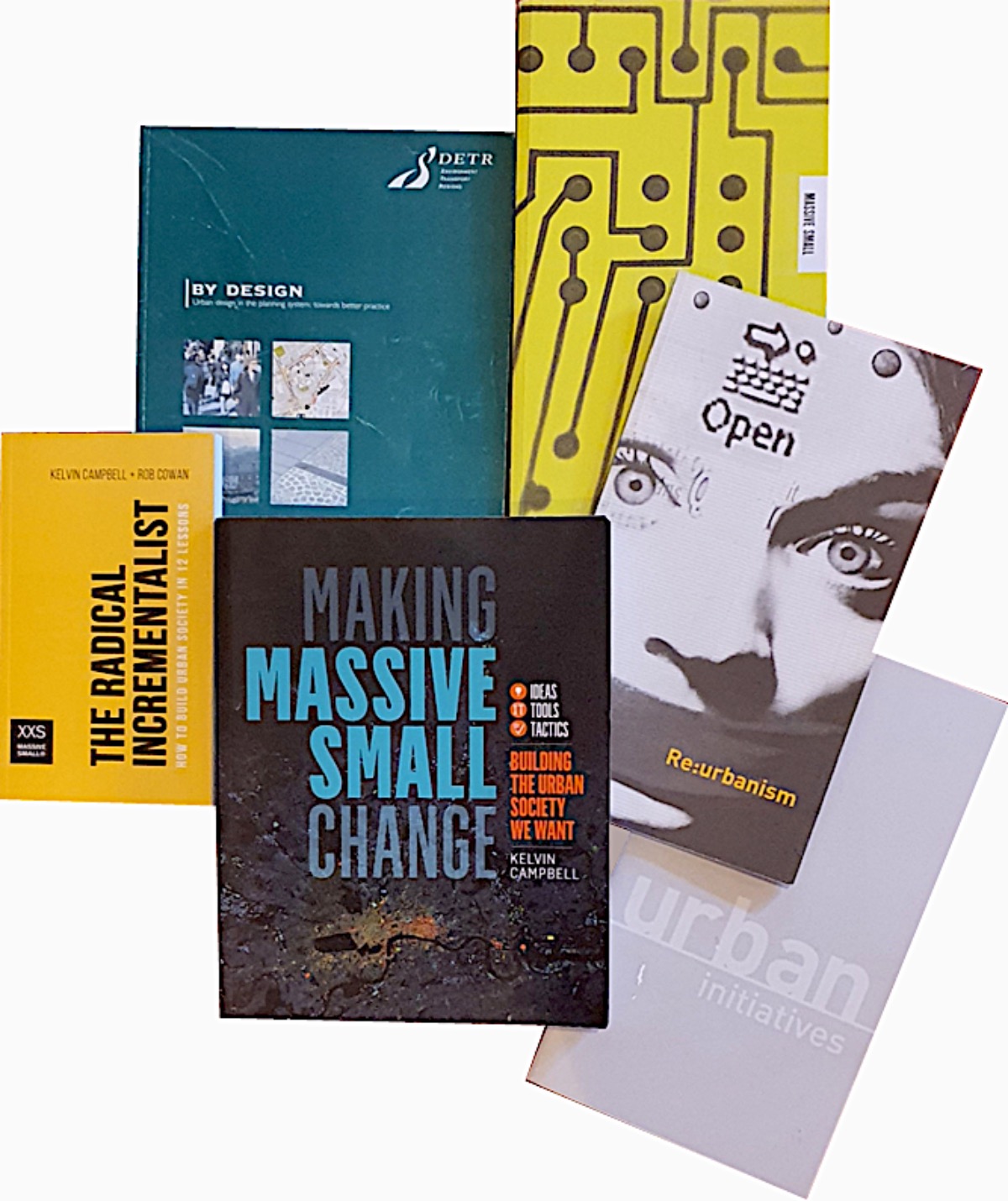
In 1996, the UK government commissioned Kelvin and Rob Cowan to write what was to be the first central government design guidance document since 1953. The Conservative Secretary of State for the Environment, John Gummer, had become convinced that local planning authorities should treat urban design as part of the planning process, which had until then been focused mainly on land use. The document formulated principles of urban design and showed how local authorities could embed them in their own planning policies and guidance to shape development.
Consequentially, in 2000 the government issued the work as 'By Design: urban design in the planning process'. This remained the official government guidance for 14 years, transforming how the planning process dealt with the design of development.
The Emerging 'Massive Small' Philosophy
Kelvin gradually developed a series of philosophical approaches to urbanism, commencing with Re-urbanism in 2002 and followed by Massive Small in 2011 and The Radical Incrementalist in 2016. Later, they coalesced into Making Massive Small Change in 2018.
These philosophies were essentially concerned with unleashing local autonomy. Kelvin had always felt strongly that initiatives aimed at helping communities thrive were regularly constrained by the limitations of the regulatory regimes, governance systems, and funding and development practices. The sheer weight of these constraints stifled the enthusiasm of local communities to improve their lot autonomously. However, urban professionals seldom challenged the fundamentals of how the system as a whole worked, presumably feeling it would be futile given the scale, complexity and power of vested interests. Kelvin and Rob Cowan were notable exceptions to this, as their publications attested.
The 'Radical Incrementalist' alludes to the ‘active citizen, civic leader or urban professional who harnesses the collective power of many small local ideas and actions; who focuses on catalysts and small beginnings, and scales these up; who is open, adaptive and responsive to continuously evolving urban conditions; and who learns by doing and shares their experience with others.
Topics included repurposing a failing manufacturing district into an impact hub with flourishing homegrown businesses; making unpopular cities’ reputations cool again; and building cultural and social capital by substituting mass housing projects with new neighbourhoods that re-interpret traditional courtyard buildings. A range of other innovative housing approaches is also described. These include tactical urbanism techniques to make abandoned land productive and neighbourhood-based housing initiatives delivered by many smaller entities, rather than volume house builders.
Towards a cohesive philosophy
By 2018, Kelvin was ready to pull together a cohesive and comprehensive approach to urbanism, culminating in Making Massive Small Change*. The production of this book benefited from him being awarded the Built Environment Fellowship by the Royal Commission for the Exhibition of 1851. He now had the time to develop his thinking more fully and freely.
The relentless richness of this book is best articulated by Edgar Pieterse, director of the African Centre and author of New Urban Worlds, when he wrote: "What a beautiful bastard this book is; a hybridised glossary, dictionary, manual, playbook, catalogue, manifesto, polemic and so much more. It is a stunningly curated Kama Sutra for city-making – inventive and seductive. If you have any connection with urban regeneration, in any capacity, scale or setting, spend quality time with this book and engage with its many provocations."
The book builds on the earlier Massive Small book, which convincingly argues that current top-down solutions are not working satisfactorily, as governments and big project approaches do not address the real problems. The solution lies in mobilising people’s latent creativity by harnessing the collective power of many small ideas and actions. This happens when people take control over the places they live in, adapting them to their needs and creating environments that are capable of adapting to future change. When many people do this, it adds up to a fundamental shift called making Massive Small Change.
The Massive Small book must rank as one of the most original and impactful in contemporary urbanism. It sweeps together themes and values that reach all the way back to Kelvin's formative days when working in informal settlements. Particularly poignant has been the high praise for the book by John F. Turner and John Habraken, the very visionaries whose insights propelled Kelvin on this journey some 40 years earlier.
The Massive Small Stories
In recent activities, from 2023 onwards, Kelvin's intellectual reach expanded through his Massive Small Stories podcasts. He and co-hosts Liam Black, Richard Ingleton or Isaac Barbosa interview accomplished practitioners, authors and researchers who operate within a similar paradigm as he did.
True to the massive small ethos, Kelvin engaged with his own community initiatives including efforts to mobilise the arts community to establish Wendover as the creative centre of the Chilterns and his negotiations with local landowners to develop a community hub on their land. He also edited a newsletter that encouraged locals to undertake their own transformative community initiatives.
Core learnings that Kelvin wanted to leave behind were urging urban professionals and collaborators to pursue value-based objectives; be sceptical of conventional wisdom; craft their own thinking; enable communities to act with autonomy; and avoid the harmful effects of big solutions.
Reflecting on Kelvin’s distinguishing professional attributes included the independence with which he challenged orthodoxies, especially reductionist thinking; the insight with which he distilled impactful propositions; the confidence with which he articulated them compellingly; the courage with which he defended them; and most memorably, the energy with which he delivered them.
References
*Cambell, K. (2018) Making Massive Small Change: Ideas, Tools, Tactics: Building the Urban Society We Want. Chelsea Green Publishing.
Credits
Kobus Mentz is the director of Urbanismplus in Auckland, New Zealand, and author of The Future Embraced.
The original tribute is by Kobus Mentz with support from Rob Cowan.







.jpg)
