Book Review: EcoResponsive Environments
ABout the Author/s


Authors:
Ian Bentley, Soham De, Sue McGlynn and Prachi Rampuria
Publisher:
Taylor and Francis Group http://taylorandfrancis.com
Place of publication:
London and New York
First Published:
2024
Number of pages:
244
ISBN:
9781032506227
In the early 1990s, I was tasked with introducing urban design into a fourth-year design studio—a moment that required not only a reframing of the curriculum but also the careful selection of texts to ground students in the discipline. In searching for relevant material, I encountered a handful of books that quickly became staples of the course: Finding Lost Space by Roger Trancik, The Image of the City by Kevin Lynch, The Granite Garden by Anne Whiston Spirn, and City Form and Natural Process by Michael Hough. Each text offered a distinct way of seeing the city—through space, perception, ecology, and process.
Yet among these, a small but particularly effective text stood out: Responsive Environments by Ian Bentley and colleagues. Its clarity, diagrammatic structure, and accessible language made it an ideal teaching toolkit. Students could grasp and apply its principles—permeability, variety, legibility—with relative ease, and it provided a shared vocabulary for discussing urban form. However, even at the time, one critique lingered: its limited engagement with ecology and the natural environment. While it excelled at articulating the qualities of human-centred urban space, it remained largely silent about the deeper environmental systems in which those spaces are embedded.
Years later, I heard that Bentley had long intended to revisit and update this influential work. It was therefore with considerable anticipation—and, indeed, a sense of delight—that I learned of its re-emergence in 2024 as EcoResponsive Environments: A Framework for Settlement Design. What follows is a reflection on this new volume, read through the dual lenses of landscape architecture and urban design, and with the memory of its predecessor very much in mind.
EcoResponsive Environments is, at its core, a practical book about settlement design across scales—from buildings to entire landscapes. It explicitly positions itself as a bridge between theory and practice, aiming to translate diffuse ecological knowledge into actionable design thinking. The authors argue that the complexity of contemporary design—shaped by climate change, rapid urbanisation, and systemic interdependencies—demands a new framework, one capable of addressing what they describe as the “unintended consequences” of design decisions across scales.
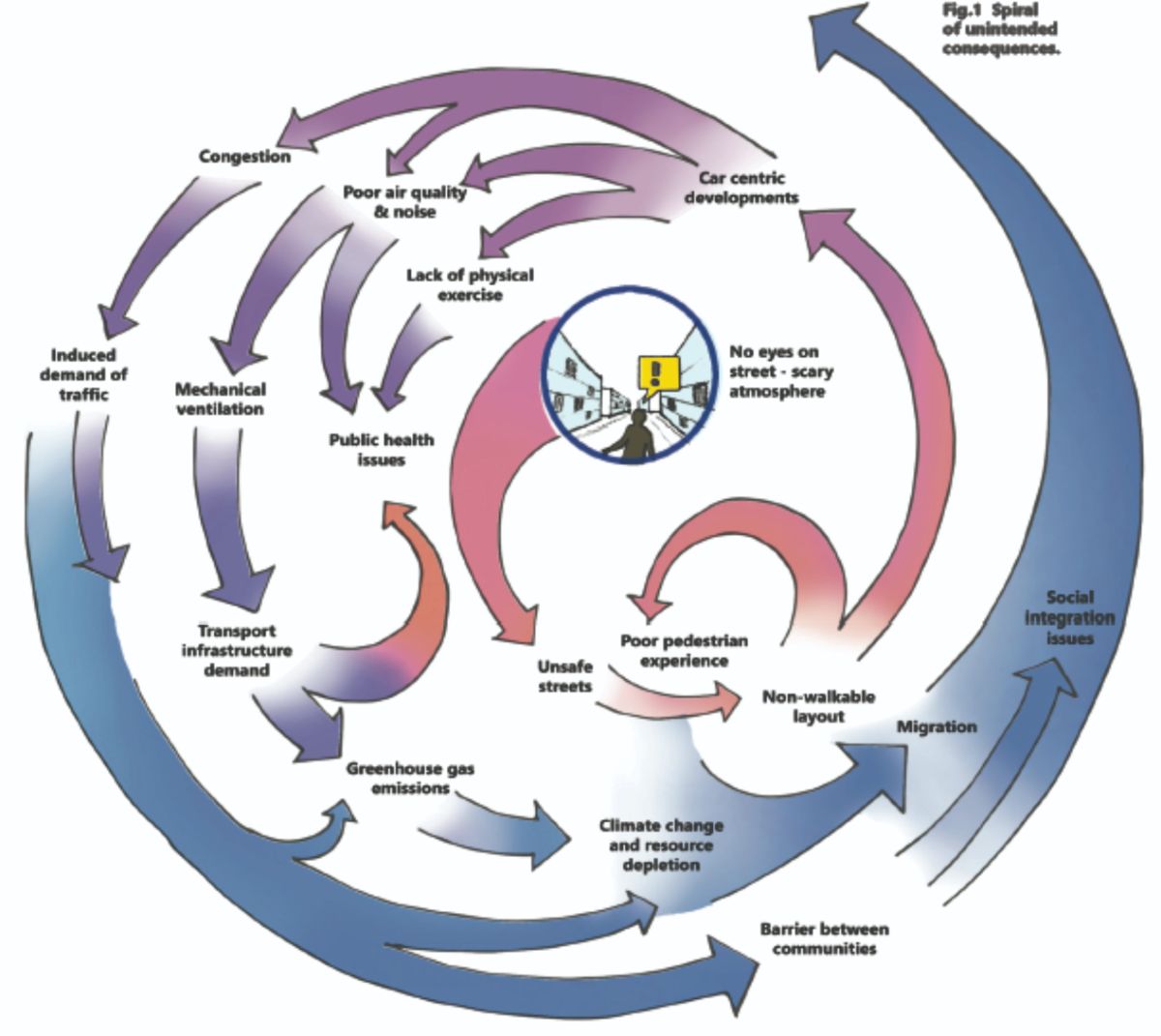
The book opens with a substantial section titled “New Ways of Thinking,” which establishes its intellectual foundation. Here, the authors situate design within the broader dynamics of the Anthropocene, emphasising how even small design decisions can cascade into large-scale environmental and social effects (as illustrated in their “spiral of unintended consequences”). This framing is particularly resonant for landscape architects, as it foregrounds the interconnectedness of systems—linking building design to mobility, health, climate, and even geopolitical instability.
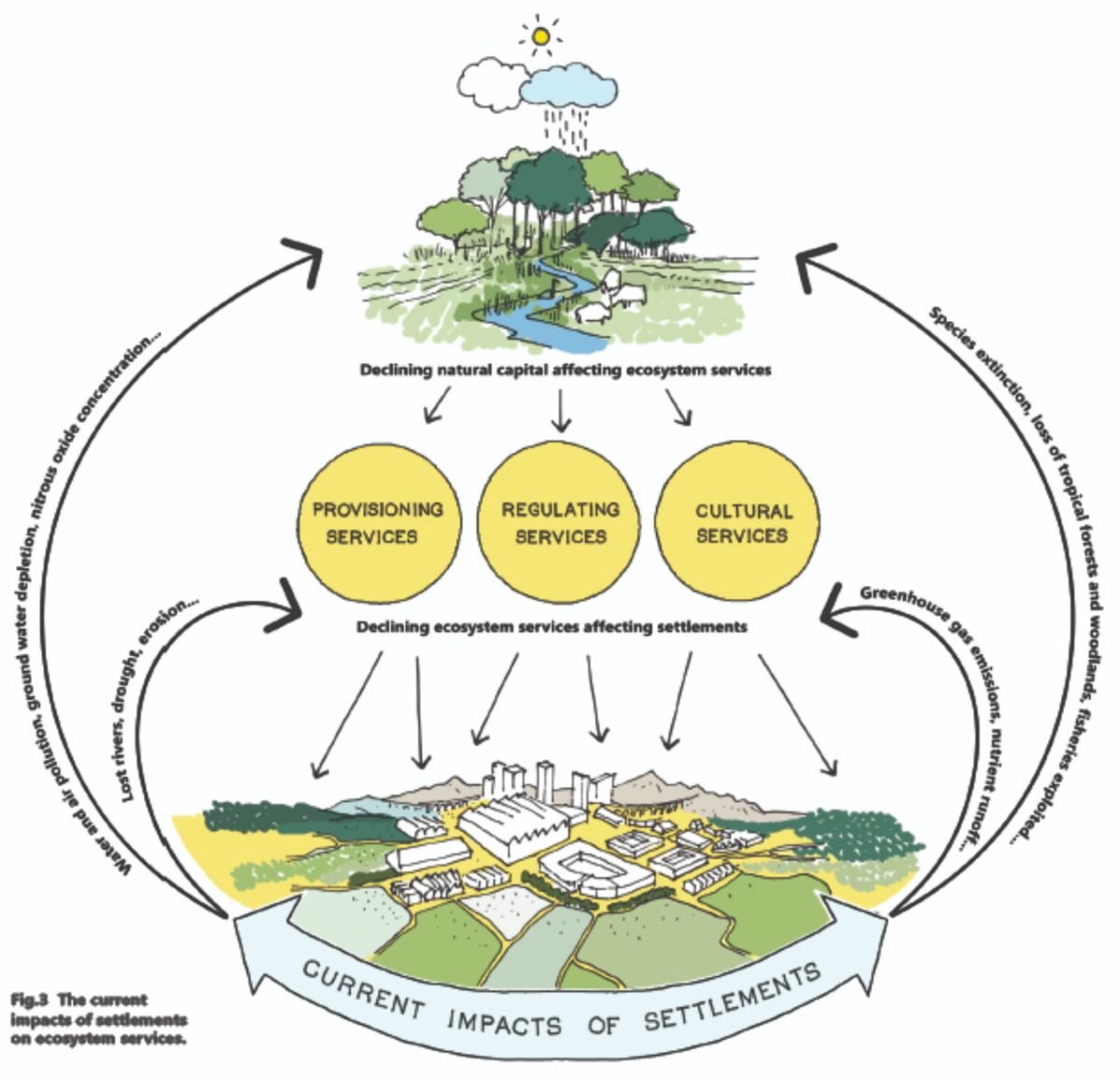
Central to this opening section is the concept of “affordances,” drawn from ecological psychology, and extended into the realm of settlement design. The authors argue that all environments offer certain possibilities for action, and that these are ultimately rooted in ecosystem services—the provisioning, regulating, and cultural benefits derived from natural systems. This is a crucial conceptual move: it reframes urban design not as the creation of isolated artefacts, but as the shaping of relationships between human needs and ecological capacities.
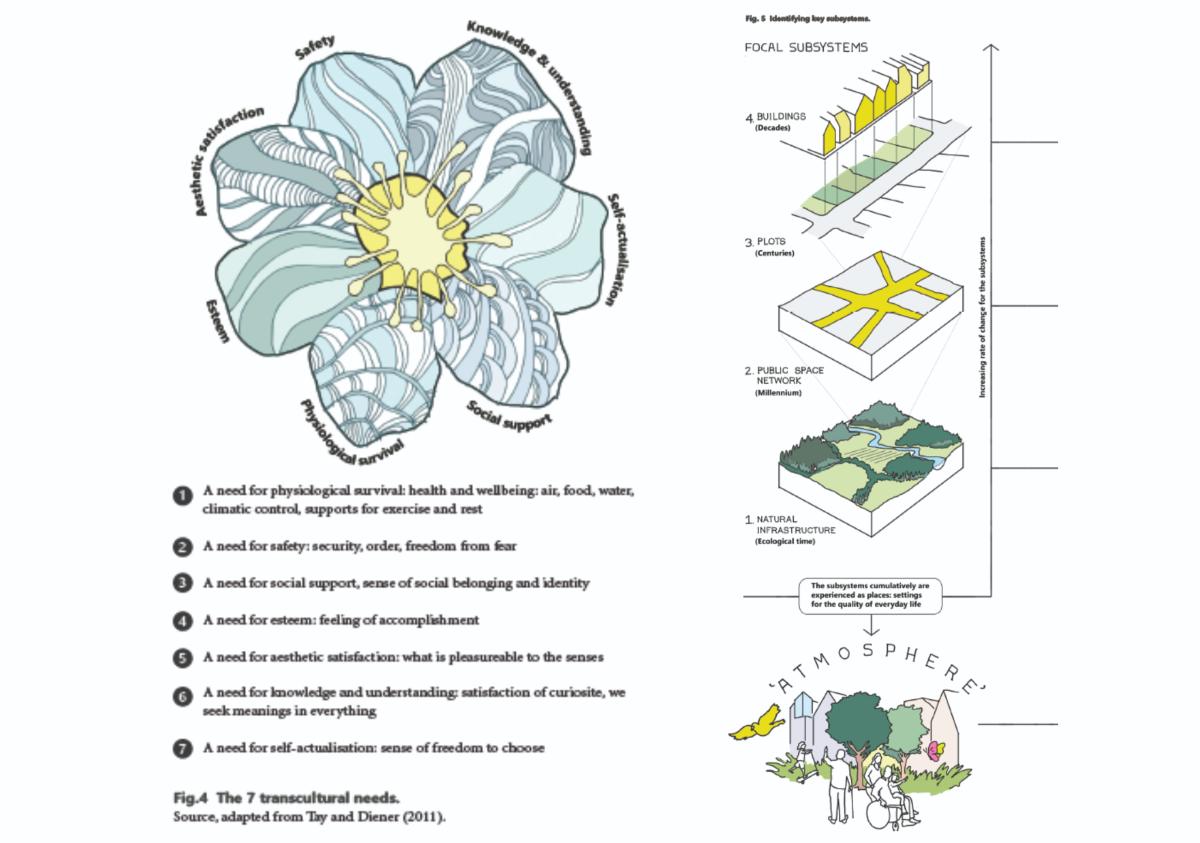
The discussion of human needs, informed by Maslow, further reinforces this integrative approach. Needs are understood not hierarchically but as an interconnected system, requiring designers to engage with multiple dimensions of wellbeing simultaneously. This aligns well with contemporary landscape thinking, where ecological performance, social use, and sensory experience are inseparable.
Perhaps the most important contribution of this opening section, however, is the identification of four key subsystems that structure all settlements:
• natural infrastructure
• public space networks
• plot systems
• buildings
These are presented not as isolated components, but as nested, interdependent systems evolving at different temporal scales—from the long-term persistence of landform to the relative ephemerality of buildings . This temporal dimension is particularly valuable, even if not fully developed later in the book.
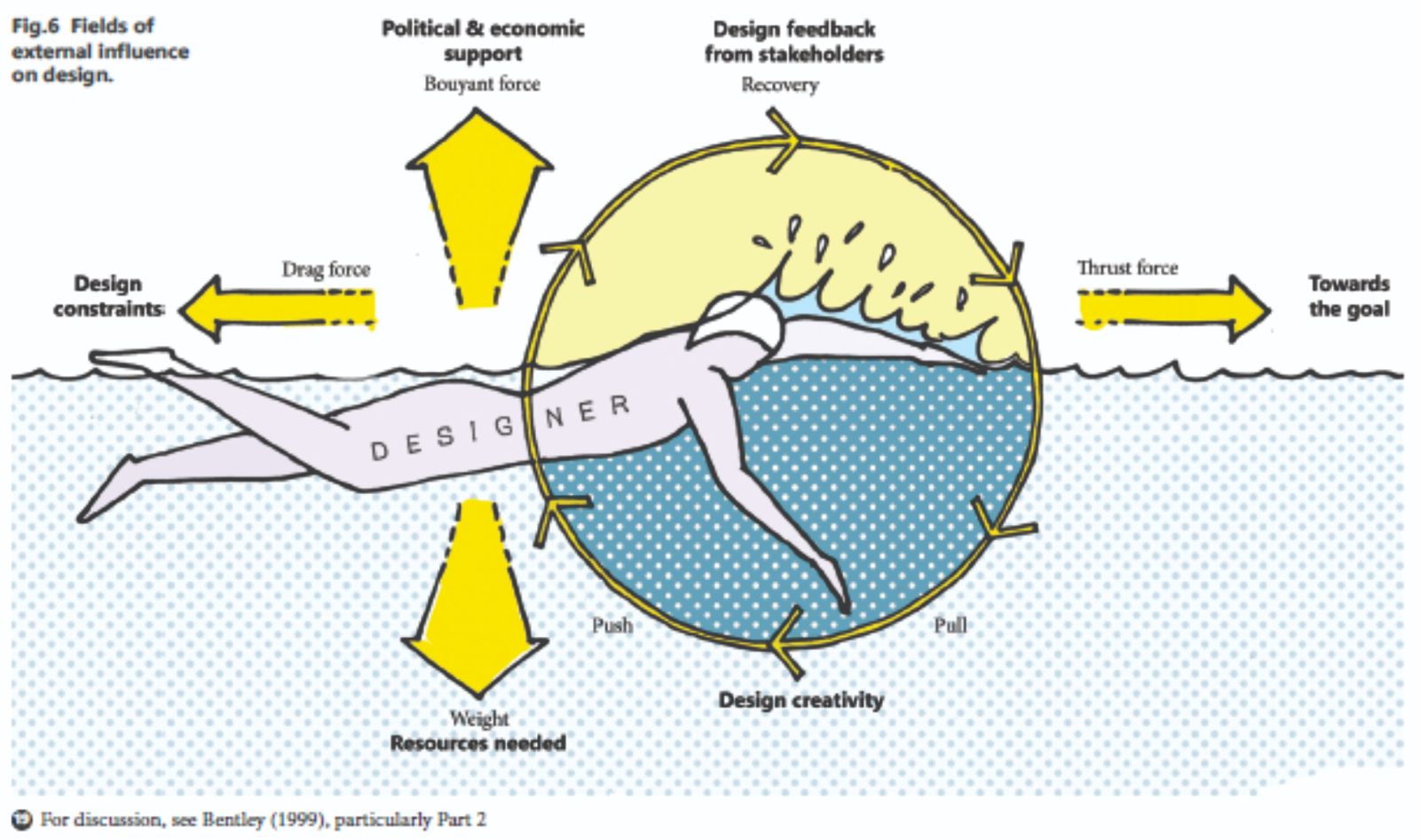
The main body of the book is organised into five chapters, each corresponding to a stage in the design process. This structure is both logical and pedagogically effective, echoing the clarity that made Responsive Environments so useful in teaching.
Chapter 1: Coupling with Natural Infrastructure begins at the largest scale, establishing landscape as the foundational system. Here, the design task is to draw out the maximum “affordances” from the site’s natural capital—its landforms, hydrology, and ecological systems. From a landscape architecture perspective, this is perhaps the book’s most significant shift: landscape is no longer background, but armature.
Chapter 2: Linking in Public Space builds on this by weaving movement networks into the natural infrastructure. Streets and public spaces are conceived not merely as circulation routes but as environments that support health, social interaction, and low-energy mobility. This reflects a growing emphasis on walkability and the public realm as both ecological and social infrastructure.
Chapter 3: Generating the Plot System introduces urban morphology more explicitly, focusing on how plots structure land use and support diversity of activity. The aim is to create adaptable frameworks that can evolve over time while maintaining spatial coherence.
Chapter 4: Integrating Buildings addresses the architectural scale, emphasising adaptability, circular economy principles, and resource efficiency. Buildings are understood as part of a broader system rather than as isolated objects.
Chapter 5: Tuning for Atmosphere shifts focus to the sensory and experiential dimension. Here, the concern is with how materials, details, and microclimatic conditions shape perception and experience. This final chapter is particularly interesting in its recognition that ecological design must also be felt—not just measured.
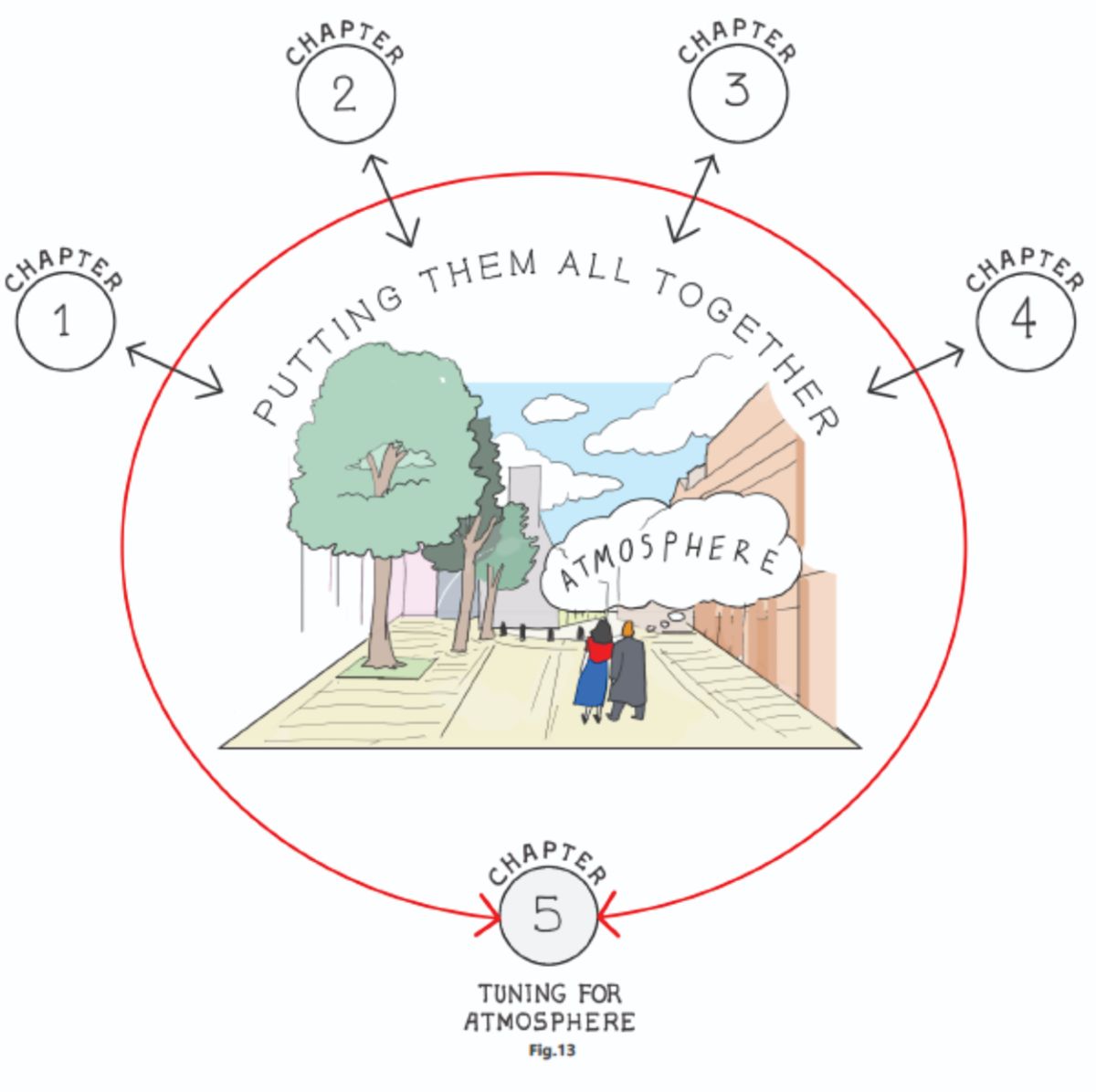
Across all chapters, a recurring methodological idea is that of “synergic parameters”—open-ended design guidelines intended to generate positive interactions between subsystems. These parameters are not prescriptive rules, but frameworks for thinking, allowing for contextual adaptation while maintaining systemic coherence.
From a landscape architecture perspective, the book’s greatest strength lies in its elevation of natural infrastructure to a primary design role. The emphasis on ecosystem services, ecological connectivity, and blue-green networks aligns strongly with landscape urbanism and ecological planning traditions. The framework encourages designers to think in terms of systems, flows, and relationships—an approach that is both timely and necessary.
At the same time, the book’s treatment of ecology remains somewhat instrumental. Natural systems are largely framed in terms of the services they provide to human settlements, rather than as entities with intrinsic value or agency. While this is perhaps inevitable in a practice-oriented text, it limits the book’s engagement with more radical “more-than-human” perspectives.
From an urban design standpoint, the book successfully extends the principles of Responsive Environments into the ecological domain. Its multi-scalar structure is particularly valuable, offering a coherent framework that links regional systems to site-specific design decisions. However, as with the earlier text, its engagement with socio-political issues—power, inequality, governance—remains relatively limited.
Compared with the ecological urbanism literature, EcoResponsive Environments occupies a distinctive and somewhat pragmatic position. Works such as Ecological Urbanism, edited by Mohsen Mostafavi, tend to operate at a more speculative and theoretical level, assembling diverse voices to explore the cultural, ethical, and political implications of ecological thinking. They are expansive, often deliberately open-ended, and at times provocative.
By contrast, Bentley and his co-authors offer something more structured and immediately applicable. Their framework translates ecological concerns into a sequence of design decisions, grounded in practice and illustrated through worked examples such as Heath Park. In doing so, they provide a bridge between theory and implementation—between the ambitions of ecological urbanism and the realities of everyday design practice.
Yet this pragmatism also marks the limits of the book. Where ecological urbanism texts often challenge the underlying assumptions of development itself, EcoResponsive Environments largely works within existing systems, seeking to improve rather than transform them. It is less concerned with reimagining urban life than with making current practices more sustainable.
Ultimately, EcoResponsive Environments can be read as both an evolution and a reconciliation. It revisits the clarity and pedagogical strength of Responsive Environments, while addressing its most significant omission: the ecological dimension. For those of us who taught from the earlier text, it represents a long-awaited expansion—one that acknowledges that responsiveness must now extend beyond human users to encompass the systems that sustain life itself.
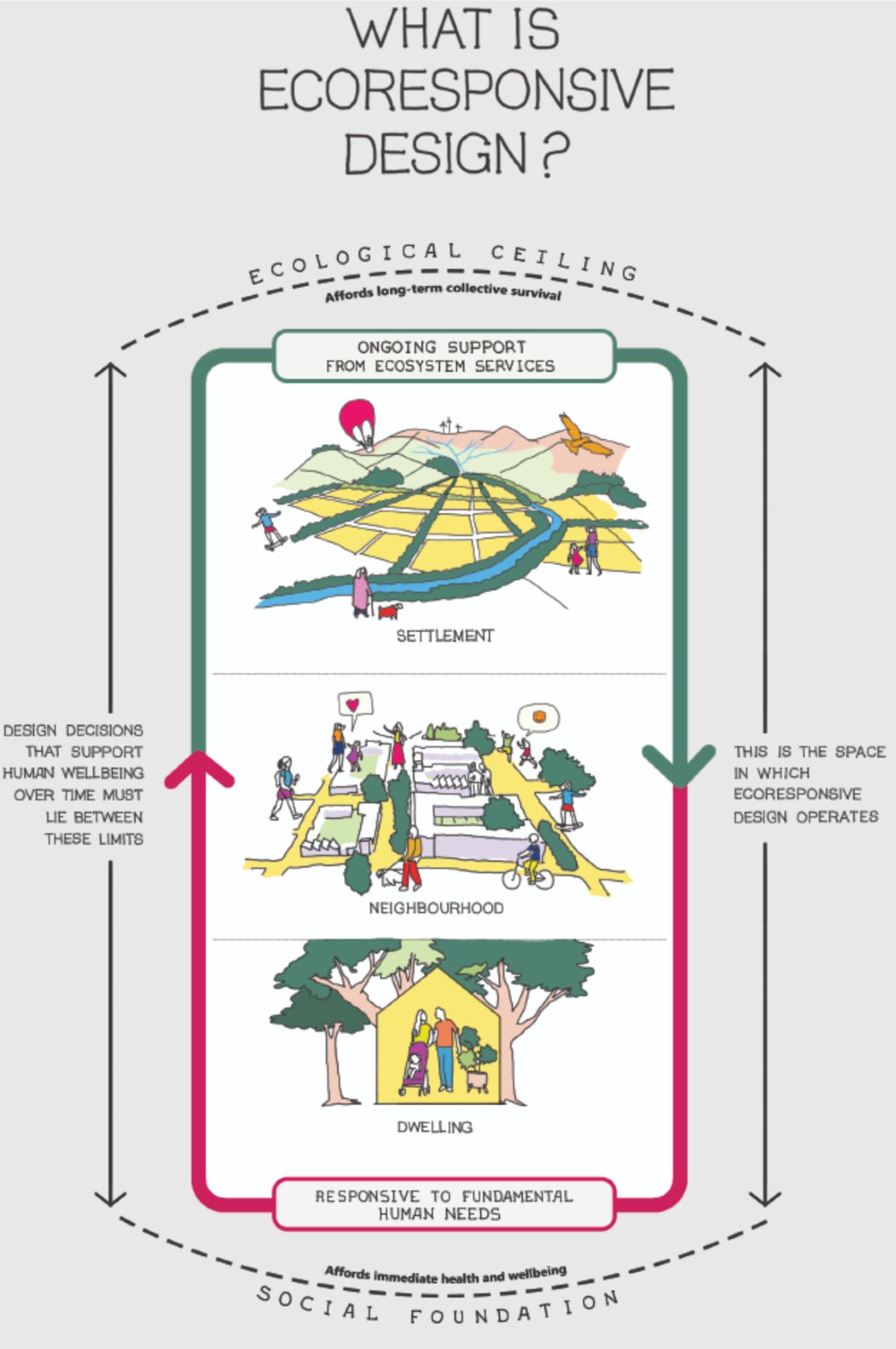
It is not a radical manifesto, nor does it attempt to resolve the profound tensions of the Anthropocene. But it offers something perhaps equally valuable: a coherent, integrative framework that brings ecological thinking and human wellbeing into the everyday language and practice of urban design and landscape architecture.






.jpg)
