

Reconquérir les friches urbaines: une pédagogie projective du paysage à l’ISA CM, Tunisie
ABout the Author/s
ENLGISH BELOW.
Une nouvelle étape institutionnelle pour la discipline du paysage en Tunisie
En Tunisie, la formation en architecture du paysage connaît aujourd’hui une évolution significative. À ISA CM (Université de Sousse), la création le 03 avril 2026 d’un département de paysage indépendant vient consacrer plus de 30 ans d’enseignement initialement porté par les sciences horticoles. Ce jalon institutionnel affirme une pédagogie désormais structurée autour du projet.
Le cursus se situe à l’interface de l’ingénierie et de l’architecture du paysage, articulant sciences agronomiques, environnementales, sciences humaines, techniques et pratiques de conception. Longtemps orientée vers la maîtrise d’ouvrage, la formation évolue aujourd’hui vers un renforcement des capacités de conception et de lecture territoriale élargie. Les ateliers de projet de paysage en constituent l’ossature, représentant près de 60 % du temps en dernière année.
Une pédagogie du projet ancrée dans le réel et les territoires
La pédagogie repose sur une progression par l’échelle et la complexité : des outils de représentation à l’analyse thématique, jusqu’à des ateliers confrontés à des situations réelles. Deux formats structurent cet apprentissage final : le diagnostic territorial à grande échelle et l’intervention sur des « espaces de reconquête » comme les friches, les carrières ou les délaissés urbains.
Des friches urbaines comme leviers de transformation et de résilience
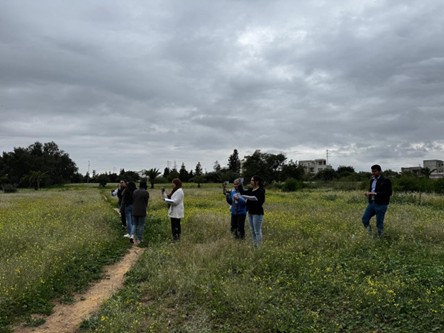
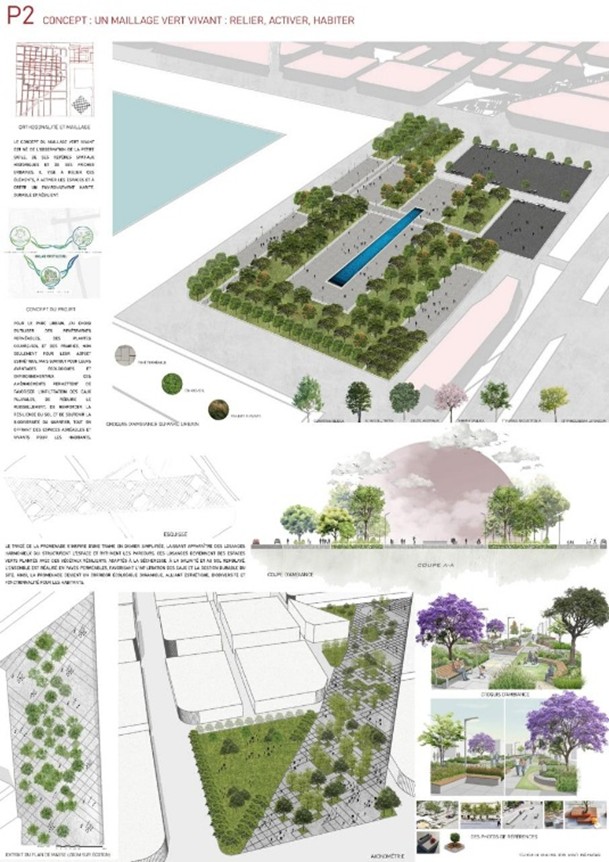
Cette année, l’atelier « espaces de reconquête » s’est concentré sur le quartier de La Petite Sicile à Tunis, territoire marqué par la fragmentation et la sous-utilisation du foncier. En partenariat avec la municipalité de Tunis et eSseda.lab, une immersion de terrain et une journée interdisciplinaire (« Mémoire de Tunis, au-delà de l’horizon ») ont permis de croiser histoire, architecture et gouvernance locale, ancrant le projet de paysage dans ses réalités.

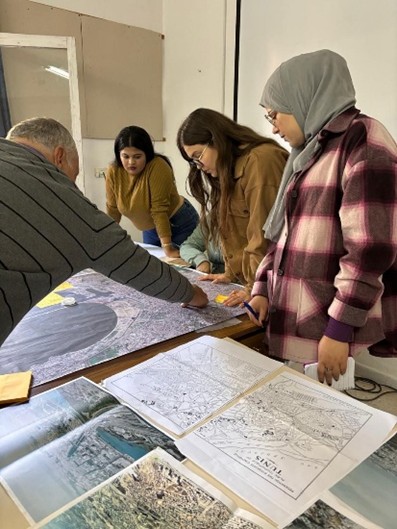
Les étudiants ont développé des stratégies opérationnelles autour de trois axes : révéler les structures invisibles du territoire, transformer les vides en interfaces actives (micro-parcs, jardins productifs, usages transitoires), et reconnecter les dynamiques urbaines entre ville, paysage et pratiques quotidiennes. Au-delà de l’exercice académique, l’atelier interroge les pratiques urbaines contemporaines en Tunisie tout en préparant les étudiants aux réalités professionnelles. Il positionne le paysage comme un outil capable d’articuler mémoire, écologie et transformation, en intégrant des enjeux tels que les infrastructures vertes, la résilience urbaine et les villes sensibles à l’eau.
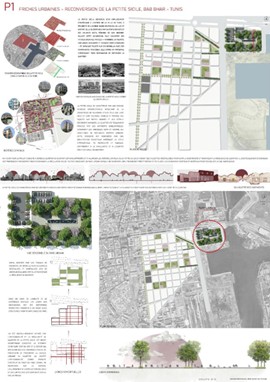
Dans un contexte de mutations rapides, ces approches contribuent à requalifier les espaces délaissés en ressources stratégiques. Elles affirment surtout une évolution nécessaire : celle d’une architecture du paysage non plus seulement descriptive ou technique, mais pleinement engagée et opérante dans la fabrication des territoires contemporains.
Reclaiming Urban Wastelands:
A Project-Based Approach to Landscape Pedagogy at ISA CM, Tunisia
A New Institutional Milestone for Landscape as a Discipline in Tunisia
In Tunisia, landscape architecture education is currently undergoing a significant evolution. At ISA CM (University of Sousse), the establishment of an independent landscape department on April 3, 2026, consolidates more than 30 years of teaching previously rooted in horticultural sciences. This institutional milestone affirms a pedagogy now clearly structured around design and project-based learning.
The curriculum operates at the intersection of engineering and landscape architecture, combining agronomy, environmental sciences, social sciences, technical training, and design practice. Historically oriented toward project management, the program is now evolving to strengthen design capacity and broader territorial understanding. Landscape design studios form the backbone of the curriculum, accounting for nearly 60% of the final year workload.
A Project-Based Pedagogy Grounded in Reality and Territory
The pedagogical approach is structured through a progressive engagement with scale and complexity: from representation tools to thematic analysis, and ultimately to studios addressing real-world conditions. Two main formats define this final stage: large-scale territorial diagnosis and site-specific interventions focused on “spaces of reconquest,” such as brownfields, quarries, and residual urban spaces.
Urban Wastelands as Levers for Transformation and Resilience
This year, the “spaces of reconquest” studio focused on the Petite Sicile district in Tunis, a fragmented area characterized by underused land and layered urban conditions. In collaboration with the Municipality of Tunis and eSseda.lab, a field immersion and an interdisciplinary workshop (“Mémoire de Tunis, au-delà de l’horizon”) brought together perspectives from history, architecture, and local governance, grounding the landscape project in its real context.
Students developed operational strategies structured around three main axes: revealing hidden territorial structures, transforming vacant spaces into active interfaces (micro-parks, productive gardens, transitional uses), and reconnecting urban dynamics between the city, landscape systems, and everyday practices. Beyond the academic exercise, the studio critically engages with contemporary urban practices in Tunisia while preparing students for professional realities. It positions landscape as a tool capable of articulating memory, ecology, and transformation, addressing key issues such as green infrastructure, urban resilience, and water-sensitive urban design.
In a context of rapid urban change, these approaches contribute to redefining neglected spaces as strategic resources. More importantly, they signal a necessary shift: from a descriptive or purely technical landscape practice toward one that is fully engaged and operational in shaping contemporary territories.
