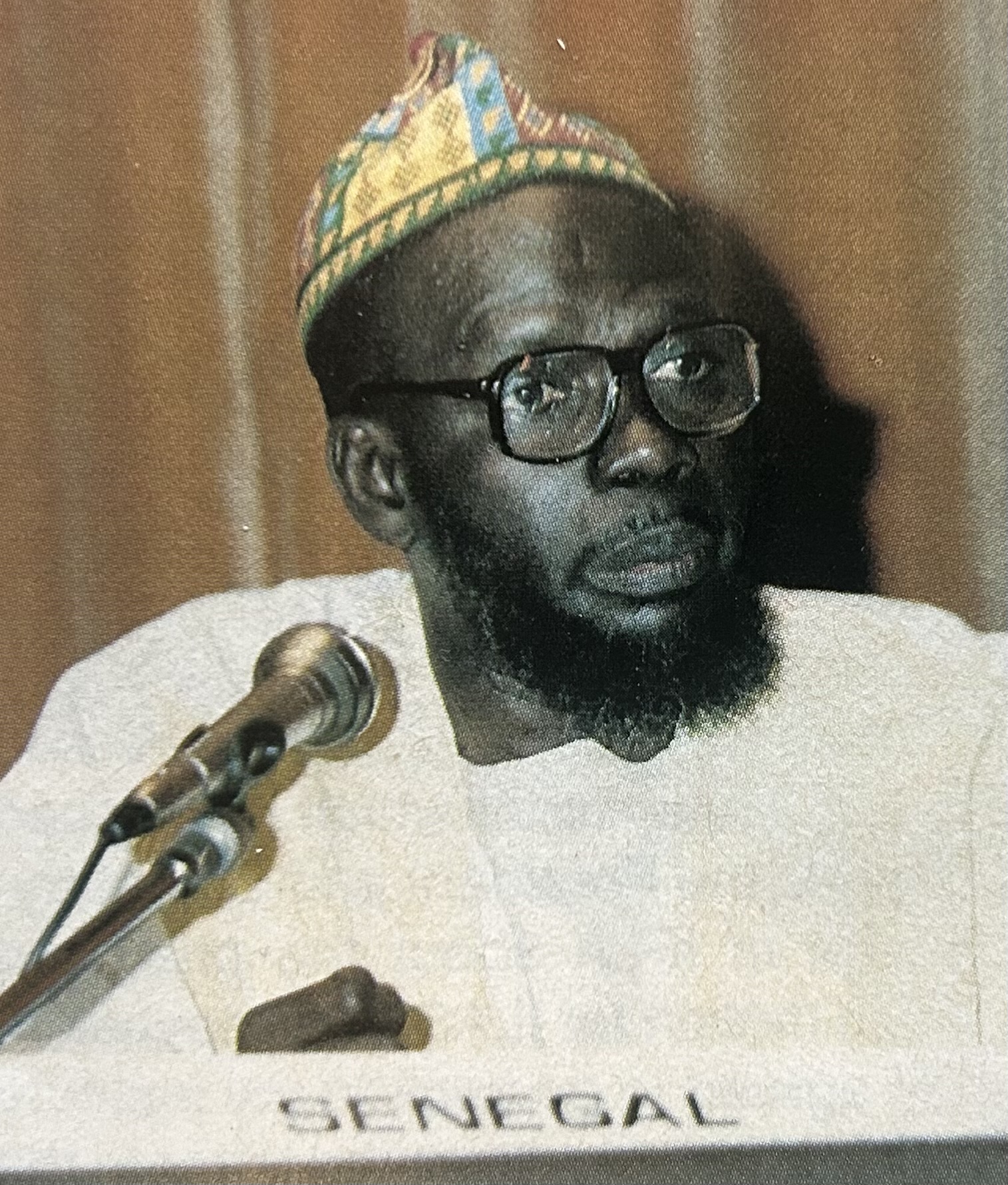

IFLA Africa's First President
ABout the Author/s

Our colleagues across the continent may be interested to know that our first President did not come from one of today’s established National Associations. This is the story.
At the IFLA World Congress in Chantilly in August 1987, two African delegates were present: Eddie Goister, representing the Institute of Landscape Architects of South Africa (ILASA), and Sheikh Abdoulaye Dièye of Senegal.
On his return to South Africa, I interviewed Goister for an article in the September/October 1987 edition of Landscape Southern Africa about his time in France. Landscape Southern Africa was ILASA’s official journal, and I served as both chair of its Editorial Board and President of ILASA.
These were the days of Apartheid in South Africa, and it was with some trepidation that Mr Goister attended the Congress. A motion caused concern. It was proposed by the Danish Association of Landscape Architects, calling for the suspension of ILASA’s membership due to the South African government's policies. In the article, Goister stated, “The voting on this motion took place on the final day of the conference, and during the two days prior to it, I was fortunate to be able to talk to a number of people informally and explain the situation in South Africa and how ILASA sees itself in the process of change and development, and that its policy was non-political and non-racial. The end result was that the issue was depoliticised and ILASA’s membership reaffirmed.”
Notwithstanding this event, the Congress proved highly relevant to landscape architecture in Africa. A fortuitous meeting occurred on the first day of the Grand Council. The full meeting was attended by some 70 delegates from 50 member countries, and because of the alphabetical seating arrangements, Goister found himself seated between the delegates from Senegal and Sweden. The official languages of IFLA were English and French (today it is only English), but because many delegates shared English as a common language, most of the proceedings were held in English. Goister was fluent in both English and French.
“After about half an hour into the meeting, the Senegalese delegate, Sheikh Abdoulaye Dièye, started asking me to translate matters from the floor for him into French, as he had no English. This caused quite a stir once people started realising what was happening – the South African delegate translating for the only black delegate at the gathering – and was also the start of a very cordial relationship which looks set to continue,” said Goister.
“It turned out that I spent a fair amount of time with Sheikh Abdoulaye, and through him, met a number of people that I would not have met otherwise. We found that, as landscape architects, there was much in common between the problems faced in Senegal and South Africa, for instance, desertification and urbanisation in the Third World.
“On the second day of the conference, which was taken up with separate meetings of the western, central and eastern regions of IFLA, I again translated for Sheikh Abdoulaye, and at that meeting the establishment of an African sub-region within the central IFLA region was agreed upon. … Sheikh Abdoulaye Dièye was elected president of the new sub-region”, concluded Goister.
This marked the beginning of a series of events that unfolded the following year. As a vote of confidence in ILASA and in the assurances it had given about its non-racial, non-political makeup, Sheikh Abdoulaye Dièye visited South Africa as one of his first official acts as president of the IFLA African regional group. In September 1988, the IFLA Central Region held a symposium in Athens, hosted by the Pan Hellenic Association of Landscape Architects and by the IFLA Central Region vice president, Mr George Anagnostopoulos. The conference attracted 130 participants from 23 countries across Europe, Africa and Asia. It was the first time that several landscape architects from across the African continent had been able to gather in one place, no doubt, in part, facilitated by Goister and Dièye’s meeting the previous year.
Dièye (1938-2002) remained active in landscape architecture and environmental planning and served in Senegalese politics, holding positions as deputy mayor of his hometown and as a member of the national parliament. He also ran for president of Senegal in 2000. He was a champion of global peace work, blending environmental design with humanitarian pursuits. Dièye travelled the world to promote nonviolence, interfaith dialogue and environmental awareness and was widely recognised as a bridge between urban design and global spiritual philosophy. He established various international centres to promote a ‘school of Peace and Service’. (The Daily Bruin Feb 14, 2002. https://dailybruin.com/2002/02/14/islamic-jewish-leaders-meet-to).
